NEW THIS WEEK!
HOLIDAY SPECIALS -- ALL ITEMS HERE ARE 60% OFF!!!

When no price is shown, use
 button to request the price.
Click on photos for larger images.
Click
 for ordering details.
 |
|
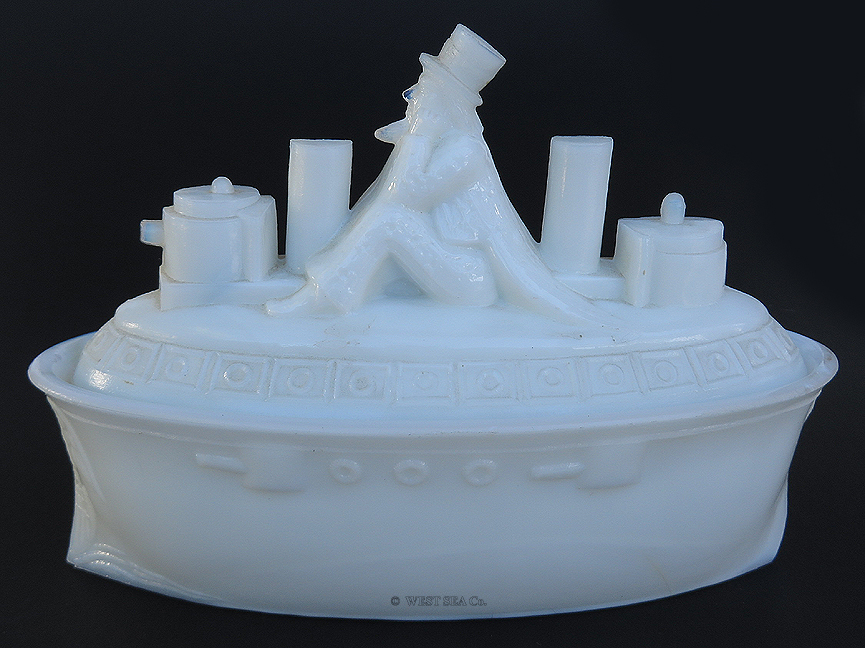
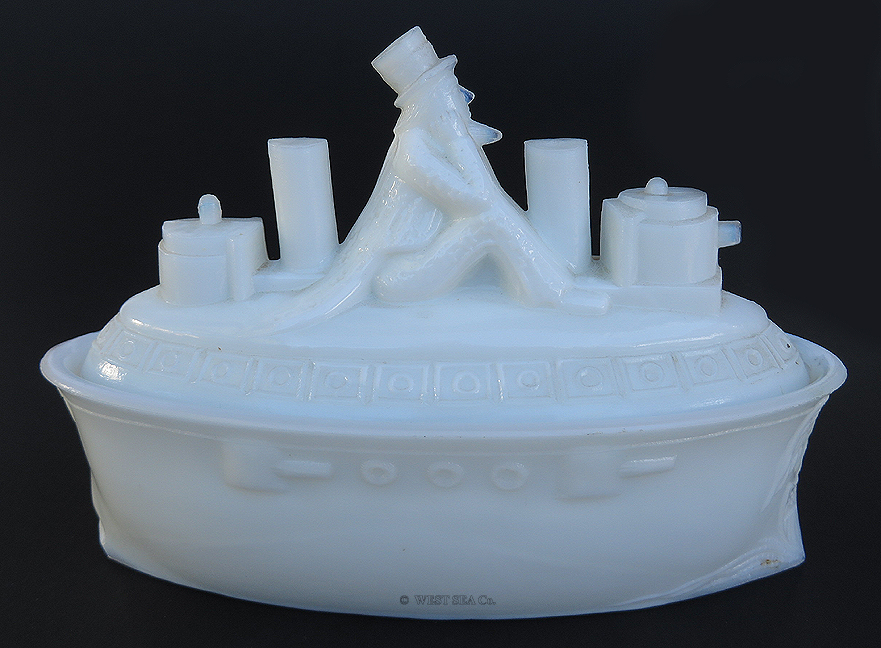
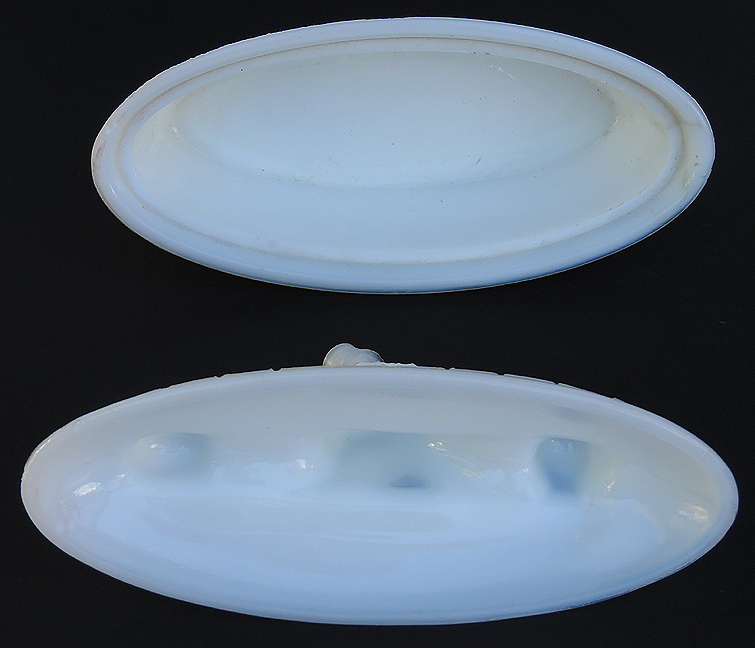
SPECIAL-1. COMMEMORATIVE CANDY
DISH. Late 19th century covered milk glass
candy dish depicting Uncle Sam astride a battleship.
This classic bit of patriotic Americana was undoubtedly
produced in 1898 when the frenzy over the sinking of the
Battleship Maine resulted in the Spanish-American War.
Hundreds of different curios were produced in that historic
year to elicit patriotic fervor in the American
people. This charming example features Uncle Sam with
top hat and long tail coat atop the Battleship Maine as the
cover. The body of the dish is the hull of the ship
having a patriotic American eagle on the bow with turret
guns and portholes cast along the sides. This
authentic relic measures 6 ¾ inches long and stands 4
¾ inches tall. Remarkable original condition for
such a potentially fragile item over 115 years old.
The only flaw is one small insignificant chip at the very
bottom rear. 195
now
79 |
 |
 |
|
REVERSE
|
INTERIOR
|
 |
|
SPECIAL-2. Genuine 19th century American ship’s pilot house clock made by the venerable Seth Thomas Company of Thomaston Connecticut. This all brass 48 hour ship’s clock in its original nickel finish has a silvered brass dial with bold Roman numerals swept by blued steel spade hands over a minute chapter ring. An inset seconds bit indicating single seconds is set below the “XII” with the Fast/Slow adjustment just above. The face is signed “SETH THOMAS” between the two winding arbors and is further marked “Made In U.S.A.” below the “VI.” It is provided with a manual striking lever on the rim of the “IX” marked “STRIKE.” This clock has a classic ship’s clock flared bezel which is hinged on the right, opening on the left for easy access to wind and set. There is a screen on the bottom of the clock which allows the pleasing bell strike to be clearly heard. 7 inches in diameter and 4 inches thick. Excellent original condition and a strong runner, showing good age and use but no abuse. Complete with winding key. 749 now 295 |
 |
 |
|
PERSPECTIVE
|
DIAL
|
 |
|
SPECIAL-3. CHINESE GOD of
WINE. Authentic, hand-thrown early 20th
century hard-fired porcelain effigy of Yi-Di, the Chinese
God of Wine and Alcohol. This genuine likeness of the
4400 year old mythological Chinese god is beautifully molded
with exquisite detail. The gaunt, bearded personage
with flowing locks and wind blown robe is depicted sitting
atop a large wine amphora riding on the waves. The
attention to detail in this statue is amazing, even down to
the veins in Yi-Di’s arms! This
traditionally-made porcelain statue has a variety of
colorful shinny and matte glazes which combine to form a
most appealing presentation. It is elaborately signed
in two areas. With some research this piece could very
well have been made by an important artist. 14 inches
tall and 9 ½ inches wide at the widest. Excellent
original condition. There are a few minor losses to
the tips of Yi-Di’s flowing hair. Otherwise
perfect. A super decorative
compliment to the bar, priced cheaper than a bottle of Two
Buck Chuck! 495
now 195
Prompted by Emperor Yu's daughter, who wanted to present her father with a special gift, Yi-Di perfected a wonderful alcoholic beverage. After much experimentation and fermentation, he arrived at a marvelous brew of fermented rice with a spicy taste. He offered it to the Emperor, who thought it was delicious but far too potent. "Of course I can handle my alcohol," said the Emperor, "But what of future Emperors?" As a result Yi-Di was banned from making more of his brew. Nevertheless his ambrosia-like concoction still propelled him to godly status. |

 |
 |
 |
|
back
|
details
|
signatures
|
 |
|
SPECIAL-4. ANTIQUARIAN BOOK.
Jacob Hazen, “Five Years Before The Mast,” 1853,
Belford, Clarke & Co., Chicago and New York. Hard
cloth cover, 444 pages. The title page
reads: FIVE YEARS BEFORE THE MAST; / or Life In The
Forecastle / Aboard Of / A WHALER AND MAN-OF-WAR. / By JACOB
A. HAZEN. / With Appropriate Illustrations.” The
original articles forming this narrative were compiled by
the author shortly after his discharge from the Navy in
1842. The language is therefore charmingly formal,
reflective of an earlier time with different life
experiences and perceptions. This is particularly true
of a seaman at sea visiting foreign ports during the age of
sail. Fascinating reading from a first hand
perspective in the Atlantic and Mediterranean, including a
shipwreck. The frontispiece is nicely illustrated with
woodblock engraving of a midshipman in the rigging.
Good original condition noting slight toning of the pages
due to age. An amazing book 160 years old! 95
now
39 |
 |
|
frontispiece
|
 |
|
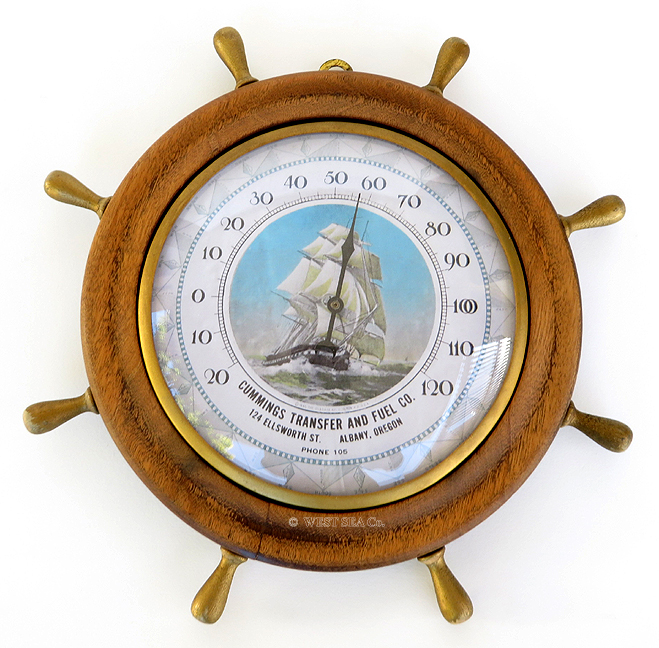
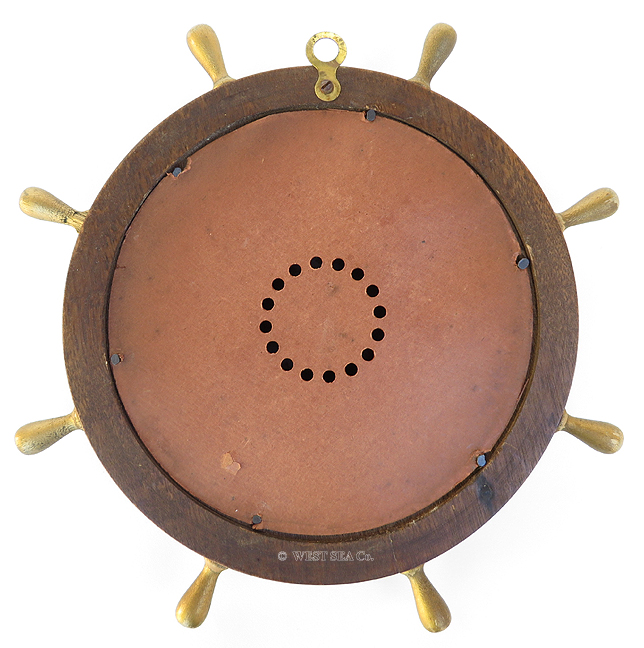
SPECIAL-5. NAUTICAL ADVERTISING THERMOMETER. Early 1900’s dial thermometer housed in a wooden ship’s wheel frame. This handsome yet functional presentation was made for the “Cummings Transfer And Fuel Co. of Albany, Oregon.” The 3 digit phone number is a testament to its age! It depicts a lovely square rigger under full sail in the middle encircled by the thermometer scale reading single degrees Fahrenheit from -20 to 120. The dial is protected by a convex glass crystal with a gilt metallic rim. The dial measures 5 ½ inches in diameter and the entire presentation is 10 inches wide from spoke to spoke. A brass hanging bracket is equipped on the back. The wooden ship’s wheel frame and 8 spokes are all turned of solid hardwood. Excellent original condition and extremely accurate! 169 now 59 |
 |
|
back
|
 |
|
SPECIAL-6. IDENTIFIABLE SHIP IN A BOTTLE. Genuine first half of the 1900’s sailor-made ship diorama depicting the famed American clippership LIGHTNING under full sail. The magnificent ship is portrayed plying a bluish white putty sea passing rocky headlands in the background guarded by a solitary sentinel lighthouse just behind the jib sails. The entire presentation is colorful and bright contained within its crystal clear glass bottle with Bakelite cap. The bottle measures exactly 9 inches long and is 3 5/8 inches in diameter. Flawless original condition, complete with its original 2 piece teakwood stand. Circa 1940. 495 now 199 |
 |
|
SPECIAL-7. ANEROID BAROMETER. Mid-century German barometer with the silvered dial marked “Weed & Company, Buffalo-Rochester.” The bottom of the dial is further marked “West Germany.” This precision weather devise has an open face dial revealing the complex, very high quality mechanism within. Incredibly, the dial is marked in inches of mercury from 26 to 31 in 2/100th increments and bears the standard weather indication in red, “Stormy, Rain, Change, Fair and Very Dry.” A beautifully reticulated blackened steel needle provides the reading while a second brass needle attached to a knurled brass knob registers changes. A convex glass crystal set in a brass bezel protects the dial. The body of this instrument consists of rich hardwood in a piano finish. The back has a black metal plate equipped with a set screw for setting. The top bears a brass hook eye for hanging. 5 ¼ inches in diameter and in absolutely perfect original condition. Functional and accurate -- all the more amazing for an instrument over a half century old! 175 now 69 |
 |
 |
|
dial
|
back
|
 |
|
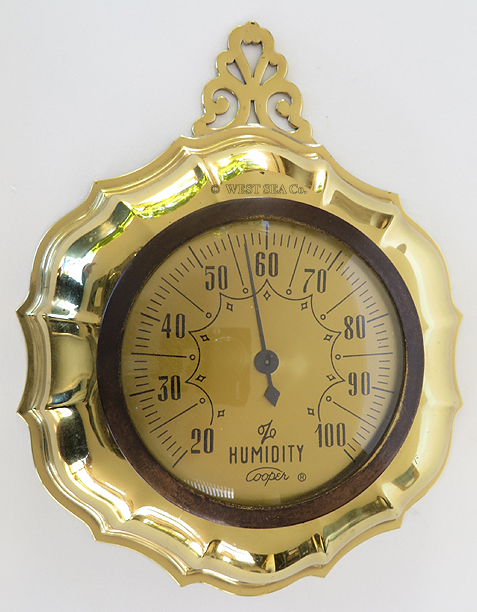
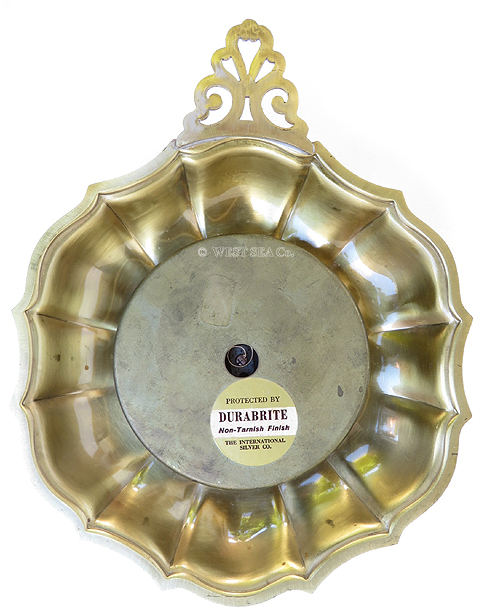
SPECIAL-8. HYGROMETER. High quality, vintage American hair hygrometer set in a highly polished solid brass case in the form of an ancient porringer ladle. This weather devise features a brushed brass dial marked “% HUMIDITY Cooper ®” calibrated in single degrees of relative humidity from 20 to 100 with a blacked steel indicator needle. The dial is covered by a convex glass crystal. The back of the instrument bears the label reading “Protected By DURABRITE Non-Tarnish Finish, The International Silver Co.” Indeed, the brass finish is immaculate. 5 ½ inches wide by 7 inches high overall. Well over a half century old. This very handsome instrument is working, however it may not be absolutely accurate. But at this price, who cares?! Really a great look! 95 now 29 |
 |
|
back
|
 |
|
SPECIAL-9. LARGE BAROMETER. Very high quality, extra nice aneroid barometer of English manufacture. This precision weather instrument features a silver dial with bold markings indicating “STORMY, RAIN, CHANGE, FAIR and VERY DRY.” The dial is calibrated in inches of mercury from 25.5 to 31.5 in 5/100ths increments and is marked “COMPENSATED.” At the bottom it is further marked “PRECISION BAROMETER, MADE IN ENGLAND.” The classic black steel indicator needle is overridden by the brass set needle with knurled brass knob which indicates the previous reading. It is set through the thick beveled glass crystal which is contained in the especially bright nickeled brass bezel inset into its wooden housing. This stout wooden body consists of a solid piece of turned mahogany in a furniture-grade finish. Inset hanging bracket on the back as well as an opening to set the movement to the proper reading. This unusually large aneroid barometer measures 10 ½ inches in diameter overall. The dial is 6 inches in diameter. Condition is outstanding in every respect, noting only a minor, virtually unnoticeable “fish eye” in the beveled glass at the very bottom. Totally original, completely functional, and very accurate. Circa 1950. As good as they come. 229 now 79 |
 |
 |
|
dial
|
back
|
 |
|
SPECIAL-10. ORIGINAL PHOTOGRAPH.
Genuine, very early 1900’s original
silverplate print of the handsome barkentine ARCHER
loading lumber alongside the dock in the Pacific
Northwest. On the ship’s prow can clearly be
seen her female figurehead clad in a jaunty hat with her arm
across her bosom and flowing trailboard behind. On the
ship’s quarter can clearly be seen the nameboard
reading “ARCHER.” Tin the foreground the
ship’s old fashioned kedge anchor hangs from the cat
and another is seen secured to the bulwark just abaft the
nameboard. This image is clear and very detailed,
bearing scrutiny under magnification. Sails are furled
on all of the yardarms in a seamanlike manner, and much deck
detail is visible. The image measures 10 ½ by 13
½ inches and is in excellent condition. It is
protected under glass within its simple wooden frame with
original backing (stained) measures 12 by 15 inches.
This is an original period print,
not a later reproduced copy. 199
now
79 |
 |
|
detail
|
 |
|
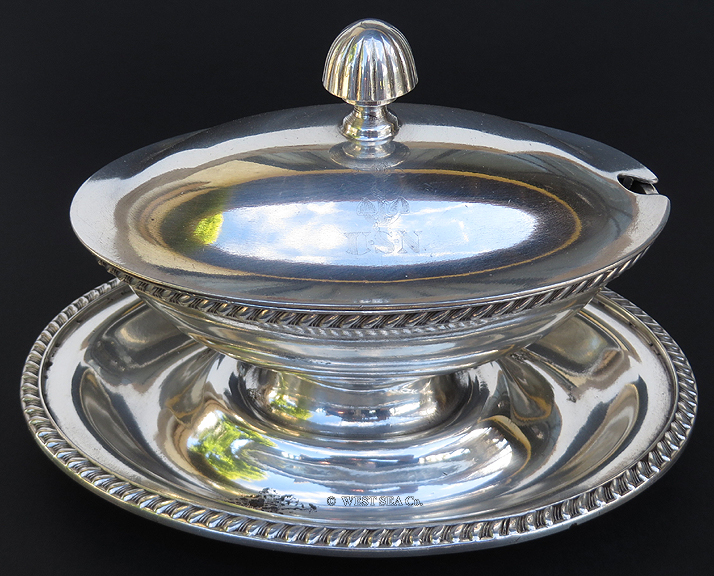
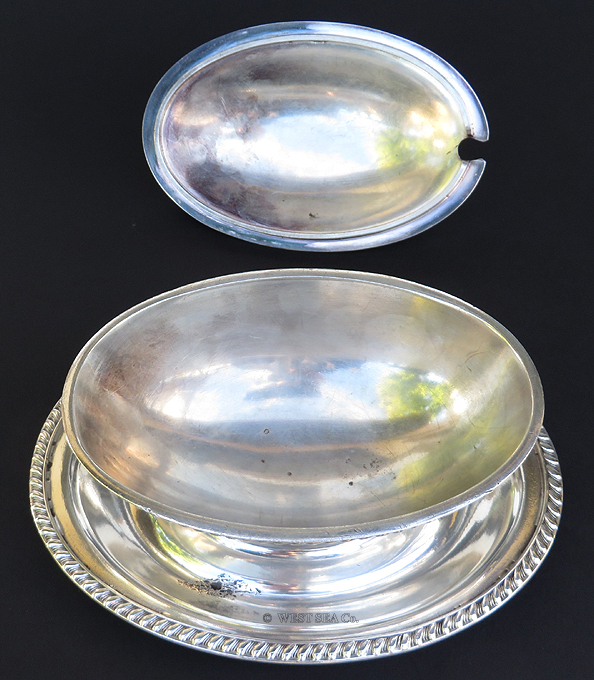
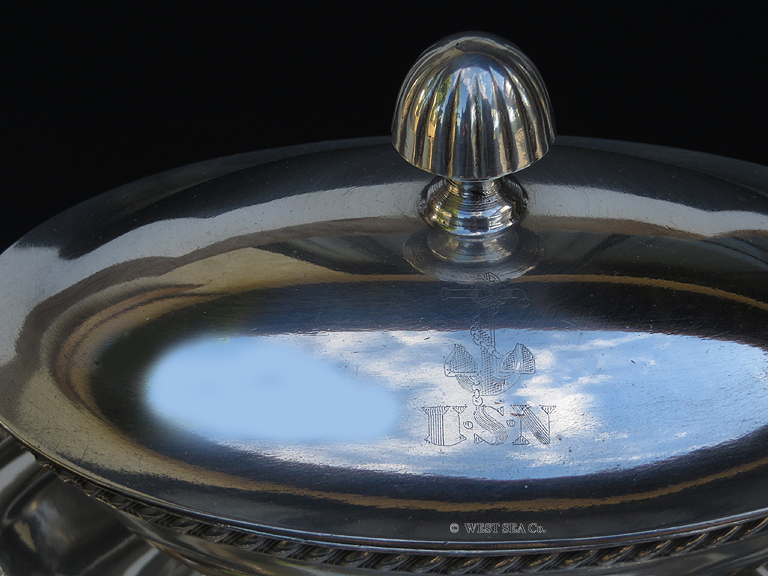
SPECIAL-11. U.S. NAVY GRAVY BOAT. World War II or earlier silverplate gravy boat from the officers’ mess of a commissioned U.S. Navy vessel. This handsome Navy relic is in the fancy “King’s Pattern” with “ropework” border, fluted acorn knob and beautifully hand-engraved emblem of the United States Navy -- the iconic fouled anchor and “U.S.N.” This gravy boat is complete with its tightly fitting lid and measures 5 inches tall by 8 ½ inches long and 6 inches wide. Excellent condition with no dents or scratches, but noting some minor discoloration and spotting. 129 now 49 |
 |
 |
|
interiors
|
usn
|
 |
|
SPECIAL-12. DIPTYCH POCKET COMPASS. Fine 19th century folding wooden compass with a brass pivot and a very handsome engraved paper card made for the English speaking market. The 2 inch diameter card is marked with a classic fleur-de-lis at the North point and boldly marked “E, S, W” at the other cardinal points with the intercardinal points also indicated. The card is further marked down to single points of the compass AND remarkably, single degrees 0-360 on its periphery! The card is housed under glass with a brass retaining ring in its mahogany body with folding lid, pivoting brass closure hook and brass caging device which automatically locks the card into place when the lid is closed. Excellent original condition. The compass is lively and accurate. A very nice example of one of these highly collectible little instruments. 239 now 95 |
 |
 |
|
case
|
detail
|