YACHTING & RACING
Catalog Page 19

When no price is shown, use
 button to request the price.
Click on photos for larger images.
Click
 for ordering details.
|
|

|
19.76 YACHT HALF HULL. Authentic, early 1900’s half block model of a sleek racing yacht designed for speed. This original builder’s model is likely American and was constructed in several laminated pine “lifts” then covered with gesso and painted in its original rich brown finish. A separate rudder is attached to the backboard just aft the keel. The hull is mounted on its old thin solid pine backboard with beveled edges in original old finish which measures 22 ¼ by 6 inches. The hull itself is 20 inches long. Under the bow there is a blank sterling silver presentation plaque affixed to the backboard. It measures 3 ¾ by 1 ½ inches. Two eyelets are fitted to the top of the backboard for mounting. The surface of the hull is alligatored and the paint on the backboard is worn. These are good signs of age with the overall presentation rated in excellent original condition. 475 |
 |
 |
 |
|
STERN
|
BOW
|
BACK
|
 |
|
19.74 FAMOUS YACHT HALF HULL.
Important, period half hull model of the
famous America’s Cup yacht WHIRLWIND.
This period half block model is shaped from a single piece
of pine with a mahogany deck. The sleek sculpted hull
is a thing of beauty with its white bulwarks and green
bottom. The hull itself measures 23 ½ inches long
and has an applied rudder. It is mounted to its
original birdseye maple backboard with decorative pine
edging measuring 27 inches long by 7 inches high. All
surfaces are original and nicely “alligatored”
with age. A most desirable, handsome and readily
displayable genuine America’s Cup relic. The J-Class was adopted for America's Cup competition in
1928, looking forward to the 1930 regatta. The Class
itself dated back to the turn of the century when the
Universal Rule was adopted. There were only 10 J-class
yachts designed and built. However, several yachts of
closely related dimensions, mainly 23-Meter International
Rule boats, were converted after their construction to meet
J-Class rules. |
 |
 |
 |
|
DETAIL
|
DECK
|
BACK
|
 |
|
19.71 YACHT FLAG POLE.
Genuine early 1900’s flag pole made of solid oak with
heavy brass fittings. At the top a solid brass finial
supports a patriotic spread-winged American eagle cast in
high relief with exacting detail. A very substantial
threaded brass coupling in the middle allows this flag pole
to screw together forming an overall length of 115 ¼
inches (9.6 feet). The gradually tapering oaken pole
is 1 3/8 inches in diameter at the widest and the brass
collar is 1 ¾ inches in diameter. The eagle has a
wingspread of 4 ¾ inches and stands 3 ½ inches
tall; 6 ¾ inches inclusive of the brass mount.
Outstanding original condition with a fine age patina to all
brass and wood surfaces. Circa 1920.
249
|
 |
 |
 |
|
COMPONENTS
|
COUPLING
|
EAGLE
|
|
|
|
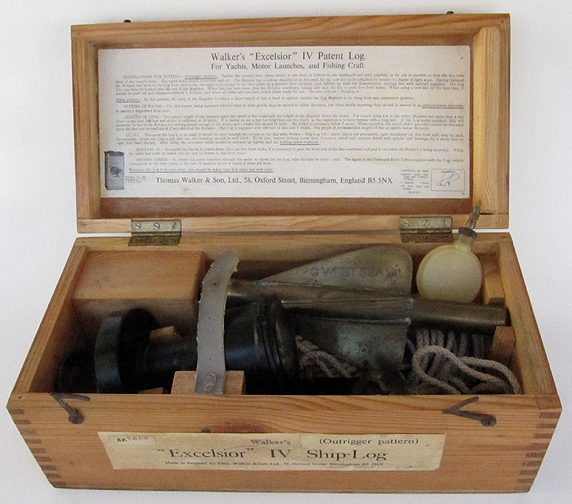
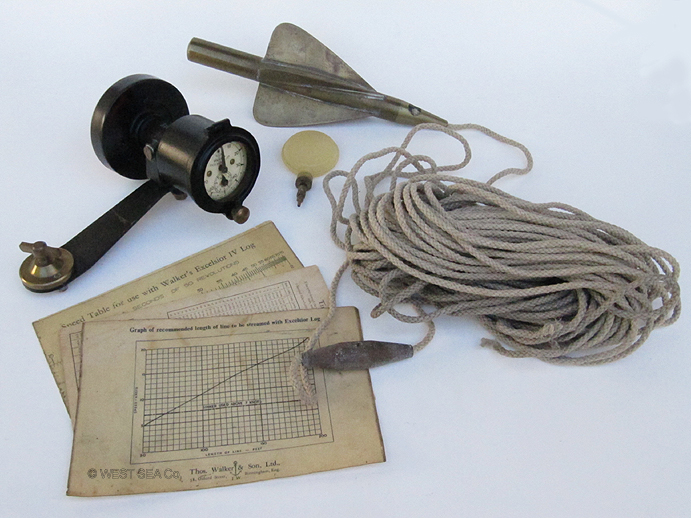
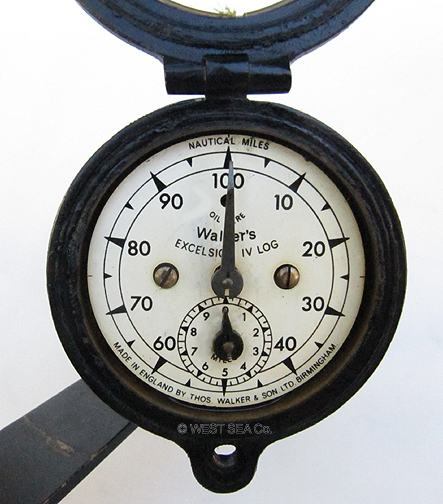
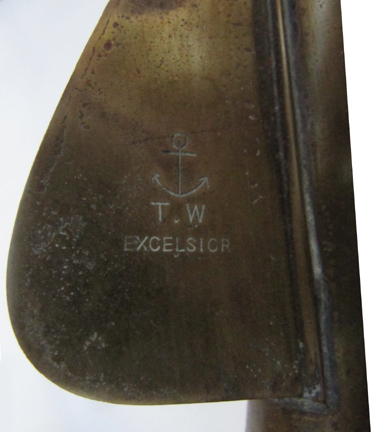
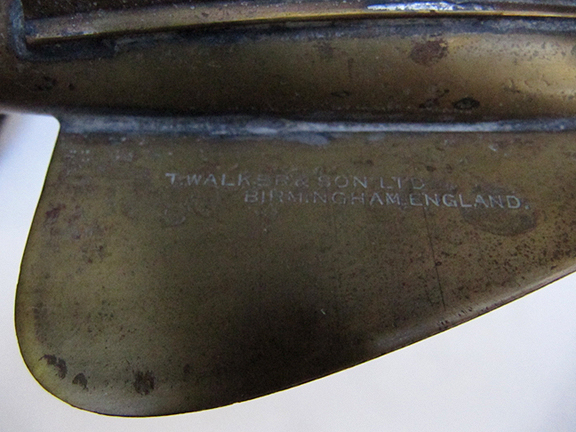
19.70 YACHT LOG. Absolutely pristine speed and distance log identified as “Walker’s “Excelsior” IV Ship Log” on the inner and outer labels and on the dial. This handsome, state-of-the-art mechanical instrument is of all brass construction. The hard-fired white porcelain register dial reads “Walker’s EXCELSIOR IV LOG, MADE IN ENGLAND BY THOS. WALKER & SON. LTD. BIRMINGHAM.” It features an outer scale marked in “NAUTICAL MILES” from 0 – 100 in 10’s, subdivided by 5’s. The subsidiary dial is divided from 0 -10 “MILES” subdivided by quarter miles. Indications are made by 2 blackened brass hands sweeping over the dial which has a glazed, hinged cover secured by a knurled thumbscrew. The register has a heavy brass flywheel painted red with a center eyelet for attaching the line to the rotor. To these ends the brass rotor (also known as the “fish”) has four fins, each marked “T.W. EXCELSIOR” with the firm’s anchor trademark. It is attached to several fathoms of original braided cotton line having a lead weight. The register is complete with its original pivoting bracket and “shoe” marked “PORT” and “AFT” for mounting to the vessel. It even retains a hand-held brass-tipped oiler! The entire unit is contained in its original machine dove-tailed pine box with brass hinges and hook closures. The lid contains the original signed label reading (in part) “Walker’s “Excelsior” IV Patent Log For Yachts, Motor Launches, and Fishing Craft.” Also included are 3 tables printed on stiff cardboard. The first is titled, “Speed Table for use with Walker’s Excelsior IV log.” The second is titled, “Graph of recommended length of line to be streamed with Excelsior Log.” The third is entitled, “Time and Knot Table” and “Table of Nautical and Statue Miles.” The perfect porcelain dial measures 2 ¼ inches in diameter and the register is 6 ¼ inches long. The box measures 15 by 7 ¼ by 6 inches. This unit has obviously never been used! As such it must be rated as being in “factory new” condition. 649 |
 |
 |
 |
 |
|
INBOX
|
LABEL
|
CONTENTS
|
LOG
|
 |
 |
 |
|
DIAL
|
LOGO
|
MAKER
|
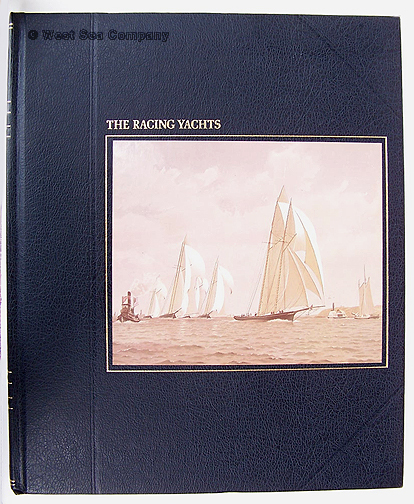 |
19.66 YACHT HISTORY REFERENCE BOOK. Yet
another of the beautifully-illustrated, action packed books
from the Time-Life series The Sea Farers. This lovely,
hard bound faux leather cover book contains 173 pages exclusive of
index. Authored by maritime expert and historian A.B.C.
Whipple, it was published by Time, Inc. in Alexandria, Virginia in
1980. The book begins in 1661, documenting the meeting between
two Royal yachts sailing down the Thames. There was the
CATHERINE with King Charles II aboazrd, and the yacht
ANNE with the King's brother, the Duke of York. To
spectators it looked like a lavish floating party. But what
they were actually witnessing was the first
yacht race in history! From there the book chronicles the
advent and advance of yacht racing through more than 3 centuries.
Engendered by the Great London Exhibition of 1851, the 50
Guinea Cup Race, run around the Isle of Wight, featured upstart
America’s namesake pitted against the most prized vessels of
the Royal Yacht Squadron. Queen Victoria was in
attendance. The astounding outcome has perpetuated an
international yachting rivalry known ever since as the
America’s Cup. This informative
book covers those races at length: technological advances, the races
themselves and the personalities of the great yachtsmen who made the
races happen. A chapter follows which deals in depth with the
other great ocean races: The Transatlantic Races and The Kaiser’s
Cup, culminating in the "Whitbread Race" of open ocean yachts around
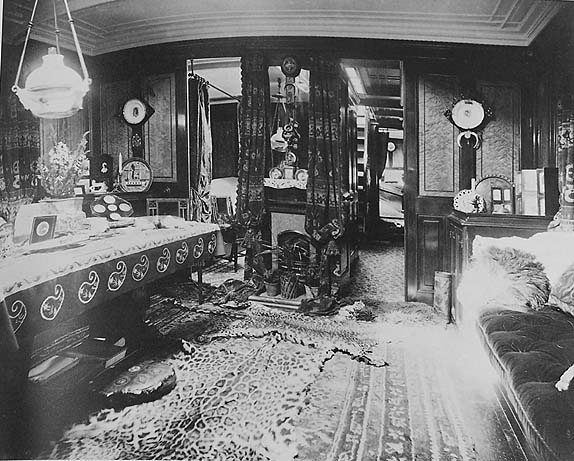
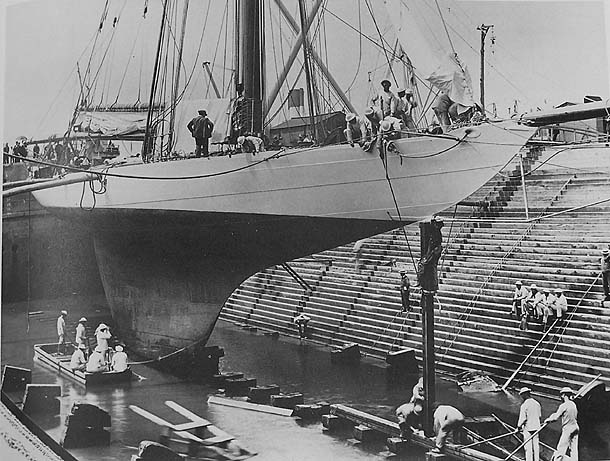
the world in 1973. Profusely illustrated in color and black and
white with paintings, drawings, period photographs and
diagrams. This is a “must have” book for the
yachting enthusiast! One original copy
only. 
 |
 |
|
|
|
|
|
PLATE 3 |
PLATE 4 |
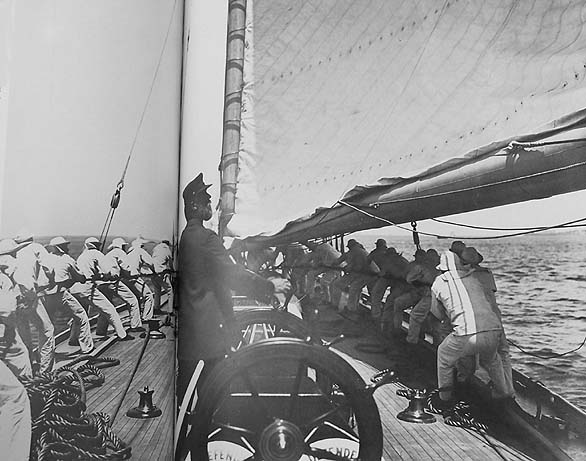
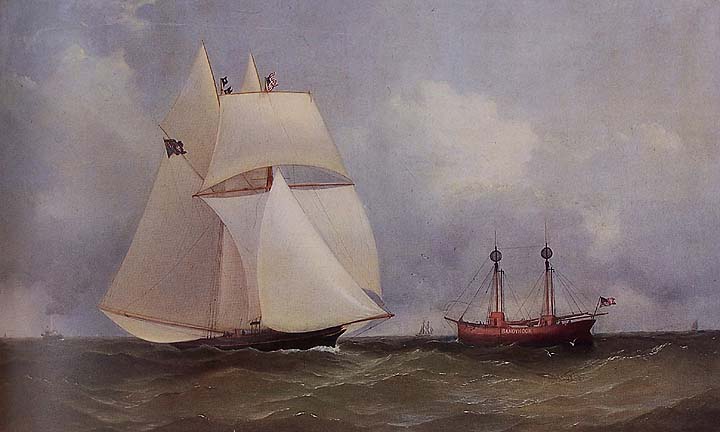
 |
19.45 IDENTIFIED YACHT BAROMETER. Highly collectible turn-of-the-last century yacht barometer with the back beautifully hand-engraved "N.Y.Y.Y.C. Secret" in fancy script. This quality aneroid barometer is of solid brass with a white enameled dial reading from 25 to 32 inches in .02 inch increments, marked with the standard weather indications "Rain, CHANGE, Fair," etc. The dial is signed "WILLIAM SENTER & Co. PORTLAND Me" and is further marked "HOLOSTERIC BAROMETER PNHB" at the bottom. It has a delicate blued steel indicator needle under the original old wavy glass which has a brass set needle with knurled knob. The body of barometer is housed within a period, custom-made mahogany mount with suspension loop for attachment to the yacht's bulkhead and measures 7 1/4 inches in diameter overall. The dial itself measures 4 1/2 inches. The entire presentation is in outstanding original condition with a great old age patina on all surfaces. The finish of the wooden case is original with the old variegated surface so sought after by collectors. The back of the case has been lightly cleaned to enhance the inscription. Fully functional. A rare, identified American yachting relic. 895
The New York Yacht Club Yacht SECRET was a 32 foot sloop built in 1907, designed by the famous yacht builders and designers, Burgess & Packard of Marblehead, Massachusetts. As late as 1927 she was still active, owned by J.P. Story of Washington, D.C. (Lloyds Register of American Yachts, 1927 Ed.)
Paul Naudet, Holosteric (aneroid) Barometer maker, "PNHB," was France's premier maker of quality aneroid barometers in the late 19th and early 20th centuries. Until his death in the 1920's, the prestigious Chelsea Company used only barometers made by Naudet for their world renowned clock/barometer sets.
 |
 |
 |
 |
|
|
|
|
|
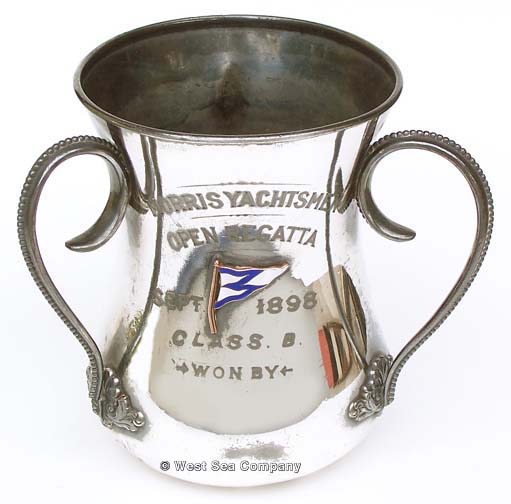 |
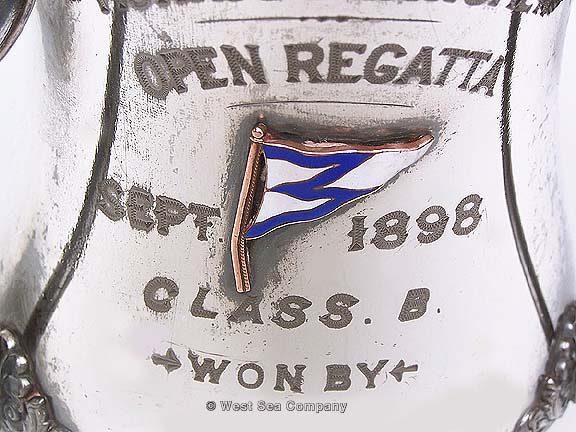
19.62 EARLY YACHTING TROPHY. Genuine, late 19th century American presentation loving cup with the fancy hand-engraved inscription:
Open Regatta
Sept. 1898
Class. B.
->Won. By<-"
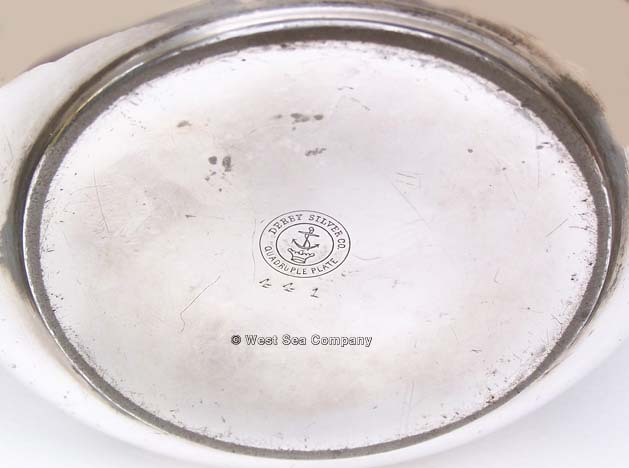
Within the date is affixed the colorful cloisonné burgee of the Morris Yacht Club flying on a gold flagstaff. This handsome 3-handled loving cup is quality silver-plate marked on the bottom "Derby Silver Co., Quadruple Plate 441" with a crown above a fouled anchor. The cup stands 6 inches high by 4 1/2 inches in diameter and 6 1/2 inches wide handle to handle. It is in good overall condition with a few minor dents, scratches and wear indicative of its 110 years. 395
According to "Lloyd's Register of American Yachts," 1925 edition, the Morris Yacht Club of Pelham Bay Park, Long Island Sound, New York was organized in 1899 and incorporated in 1900. Interestingly the inscription on this trophy "Morris Yachtsmen" with a date of 1898 suggests that this trophy predates the formation of the actual yacht club by a year!
The Derby Silver Company was a manufacturer of silver plate flatware and hollowware in Derby, Connecticut. It was one of the original companies that joined together to form the International Silver Company in 1898. It was also known by the name of the Derby Silver Plate Company. Again, the date of 1898 suggests a time of transition for this manufacture and indicates that this cup was one of the last that Derby made.
 |
 |
|
|
|
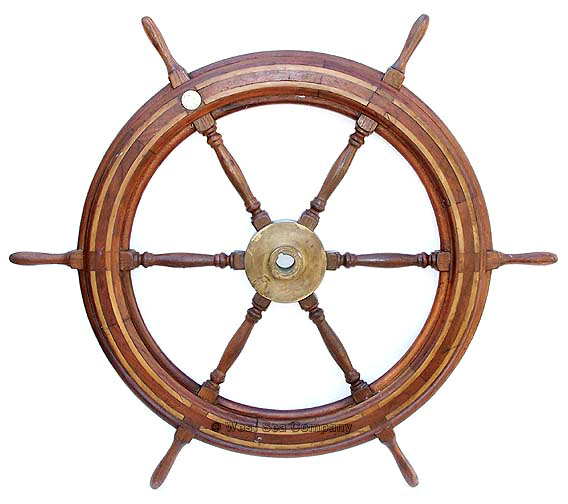 |
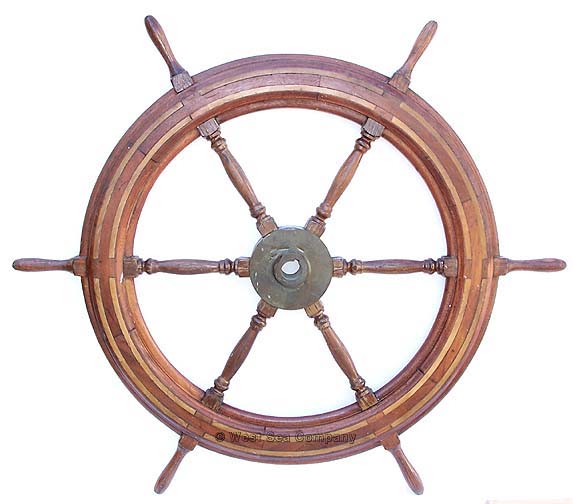
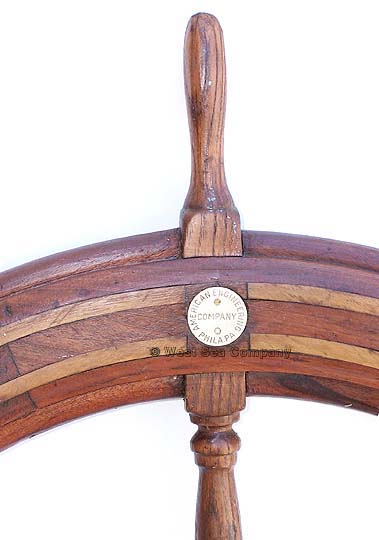
19.60 YACHT WHEEL WITH IDENTIFIED MAKER.
Very handsome turn-of-the-last century steering wheel from a
major yacht. This classic 6 spoke helm bears the inlaid brass maker's
plate reading "American Engineering Company, Phila. PA." It is
beautifully constructed with a hefty laminated rim consisting of teak
inlaid with two concentric rings of a lighter blonde wood, either
birch or maple, interrupted at the each spoke with inlays of
mahogany. The hub is of heavy solid brass with a key way
corresponding to the king spoke identified by the maker's label. This
substantial ship's wheel measures 41 inches from spoke to spoke, 31
inches across the outer rim and weighs a hefty 24 pounds. Excellent
condition with the original old finish, showing goods signs of use
and wear, but no abuse.
 |
 |
|
|
|
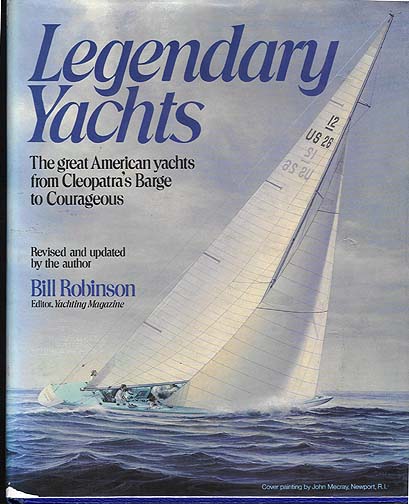 |
19.41 YACHT BOOK. Bill Robinson, "Legendary Yachts, The Great American yachts from Cleopatra's Barge to Courageous," 1978, David McKay Co., New York, 306 pages, hard cover with dust jacket. The title tells it all. This book, written by the former editor of "Yachting Magazine," is a comprehensive treatment of yachts in America begining with the Salem-built CLEOPATRA'S BARGE in 1816 through such names as AMERICA and CORSAIR, ending with Ted Turner's America's Cup winner COURAGEOUS in 1977. Copiously illustrated. Mint condition. 69
 |
 |
|
|
|
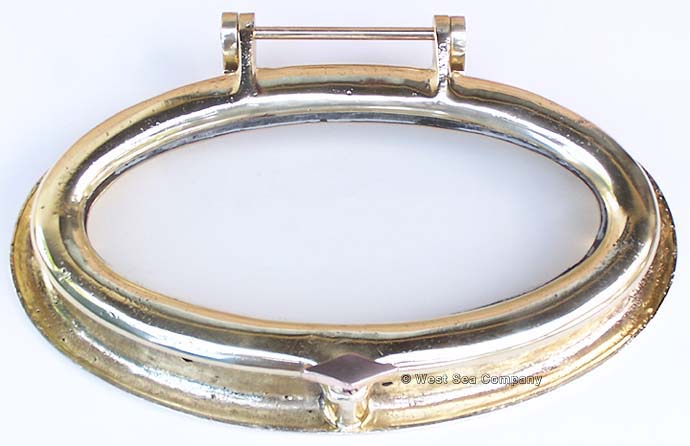 |
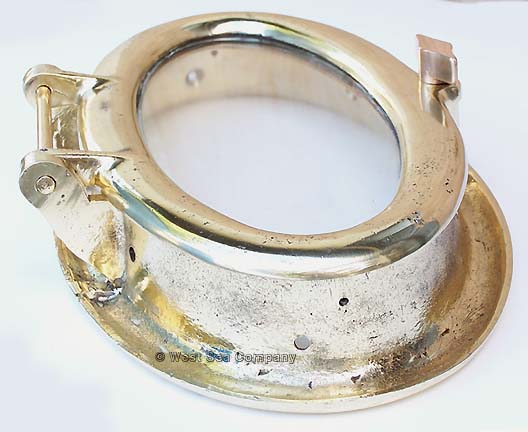
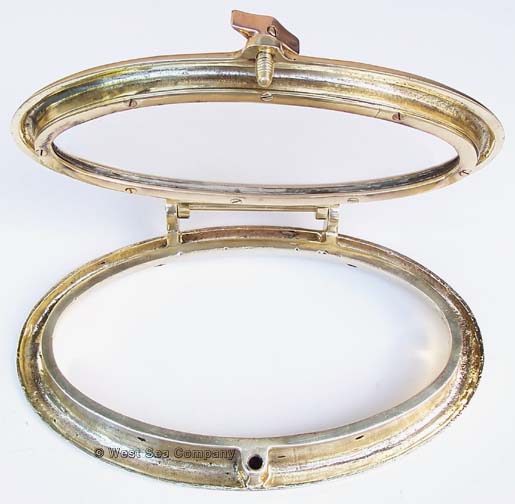
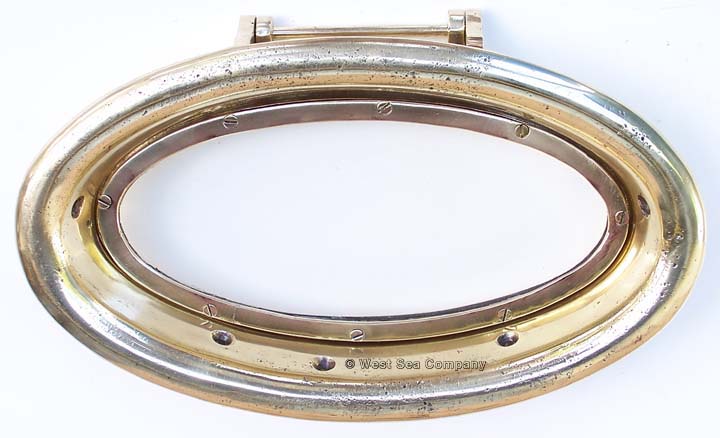
6.96 YACHT PORTHOLE. Unusual late
19th or very early 20th century porthole from a wooden hull American
sailing yacht. This opening porthole is made entirely of heavy cast
brass with the outer frame designed to be inset into the vessel's
hull, secured with 7 large wood screws. The hinged port glass opens
from the bottom and closes tight with a T-shaped bronze thumb screw.
There is a space between the frame and port to accommodate a gasket.
What makes this porthole so desirable is its pleasingly aesthetic
oval form. It measures 15 1/4 inches wide by 9 1/2
inches high and is designed for a hull thickness of 1 3/4 inches. The
thick tempered port glass measures 11 1/2 inches wide by 5 inches
high. Outstanding restored condition with a lustrous finish sealed
against tarnishing. Weighs 20 pounds.
795
 |
 |
 |
|
|
|
|
 |
 |
 |
 |
 |
 |
 |
 |
 |
 |
 |
 |
 |
 |
 |
 |
 |
 |
 |
 |
 |
 |
 |
 |
 |
 |
© 1998-2014 West Sea Co. All rights reserved.