 |
 |
 |
OUTSTANDING NAUTICAL ANTIQUES AND ART SOLD FROM THIS WEBSITE
|
|
|
|
|
|
OUTSTANDING NAUTICAL ANTIQUES AND ART SOLD FROM THIS WEBSITE
 |
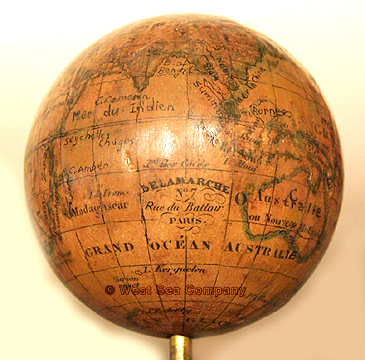
ARMILLARY SPHERE Rare early 19th century model of the solar system made by the famous French globe maker Delamarche as printed on the terrestrial globe in the center. This planetary model is based on the Ptolemaic system devised by early Greek astronomer Claudius Ptolemaeus (A.D. 90 – 128) in which he envisioned the solar system as a set of nested spheres. Ptolemy’s model depicted the Earth at the center of the solar system, whereas the later (and correct) Copernican system was sun-centered. This exceptional example features a pewter equatorial ring engraved in single degrees, 0 – 360. It is supported on a cast iron strut which also houses the brass Meridian ring divided into quadrants of 90 degrees each. As mounted, the Meridian ring is free to revolve and thus indicates the sun’s declination at any time of the year. The broad diagonal paper ring is beautifully engraved with the signs of the Zodiac. The remaining horizontal rings indicate the north and south tropics and the equator. This especially fine model is in a marvelous state of preservation, considering the fact that it is over 200 years old! Museum Quality.
The first maker to produce globes in France for use by the general public was Charles-Francois Delamarche (1740-1817). Delamarche’s workshop was on Rue du Foin, St. Jacques au College Me. Gervais’, Quartier Latin. Subsequently his addresses were Rue du Jardinet, then No. 7 Rue du Battour, all Paris. Likely this sphere is the work of his son and successor, Felix.
The term Armillary sphere comes from the Latin armilla meaning hoop or bracelet. The earth is shown as a small globe in the center of the sphere which is formed by 2 rings at right angles. The tropics of Cancer and Capricorn (representing the sun’s maximum North and South declinations from the Equator) and the Arctic and Antarctic circles are represented by narrower rings. A broad ring crossing the tropic rings represents the ecliptic or path of the sun. The sphere is mounted within a Meridain ring set into the Equatorial ring. Practical use of the Armillary sphere as a solar system teaching aid was superseded by the Orrery in the early 18th century. (A. Major, Maritime Antiques, 1981, Tantivy Press, London).
 |
 |
|
|
|

 |
REFLECTING CIRCLE. Extremely rare and very important late 19th century navigational instrument in the form of a graduated circle. This exquisitely made reflecting circle (alternatively "prismatic" circle) is signed on the index arm "Th. Wegener, Berlin No. 1948" in fancy script. The scale is engraved on silver through 300 degrees, marked in 10 degree increments and divided to 10 arc minutes. In turn, the vernier scale is calibrated to 10 arc minutes divided to an accuracy of 10 arc seconds, providing a very fine reading. The opposite side of the circle is also subdivided with identical divisions, but is not marked in 10's of degrees. A second vernier is provided effectively allowing the observer to take a second reading, vastly enhancing the capabilities of such a reflecting instrument over a common sextant or octant. For reading the verniers, a unique pivoting vernier magnifier with light diffuser is mounted to a long folding brass arm, allowing the magnifier to be used in any position around the entire instrument! This instrument is equipped with an unusually long and narrow index mirror mounted to the cross arm and a prism mounted on the body as the horizon mirror. Six sets of pivoting sun/horizon filters are mounted in front of the prism. Just to the other side is the threaded adjustable height sight tube holder which accepts one of the three telescopic sights of varying power. The longest of these telescopic tubes is a work of art in itself, being equipped with a small rotating filter with detente on the ocular, which allows the observer to rapidly change filters in the midst of an observation without interruption. This tube is internally equipped with 4 tiny cross hairs and provides a clear, highly magnified image with an adjustable focus. The reverse of the instrument shows the two lovely sculpted rosewood handles, the sight tube adjusting knob, the index filter adjusting knob, and the index arm stop and fine adjustment knobs. This impressive instrument measures just over 10 inches in diameter on the circle and just under one foot across overall. It is in absolutely outstanding state if preservation with virtually 100% original surfaces in bright brass lacquer and black oxidized finish. It is totally complete, including three optical tubes, a right angle prismatic attachment, and even includes the original screw driver, adjusting wrenches and camel's hair brush! All of this is neatly fitted within the handsome original solid mahogany case, with dovetailed joints, brass fittings, box lock and key. The box measures 12 by 12 1/2 inches and is in beautiful condition, retaining its original, unblemished finish. This certainly is one of the most pristine and important instruments of its type ever offered for sale! As featured on the History Channel's top rated television program "Pawn Stars" in early 2010.
The advent of the reflecting circle is generally attributed to the English, who by the mid 1700's saw makers like Ramsden, Gregory, Adams, Borda and Mayer innovating and producing such instruments. Initially these instruments were used at sea to find the longitude by the lunar distance method. Oddly, perhaps because of the adverse reaction given to Mayer's reflecting circle by Captain John Campbell in 1758, the reflecting circle never really gained popularity on the English side of the Channel. By the end of the 18th century, with the widespread acceptance of the marine chronometer as a more reliable tool with which to find the longitude, reflecting circles were relegated for use in hydrographic surveying and chart making. It was left to the French and Germans to refine these complex instruments during the 19th century. The ability to measure large angles and the accuracy of averaging several observations were features which found favor on the Continent, despite the circle's inherent size and awkwardness in taking sights.
 |
 |
 |
 |
|
|
|
|
|
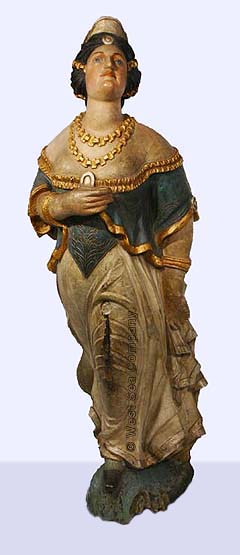 |
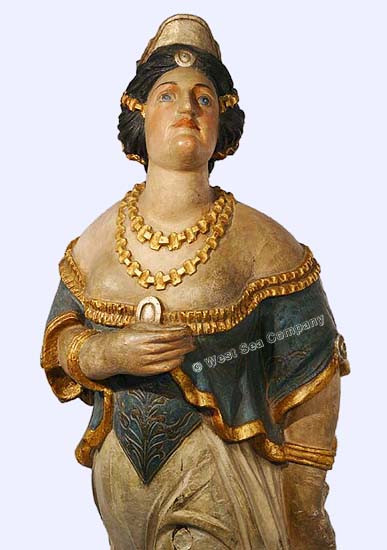
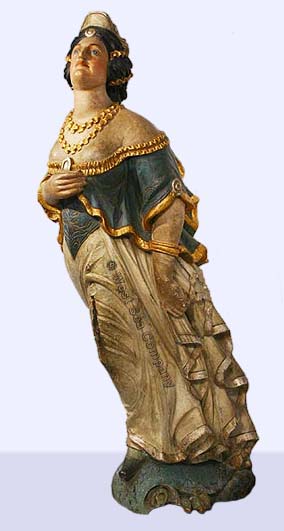
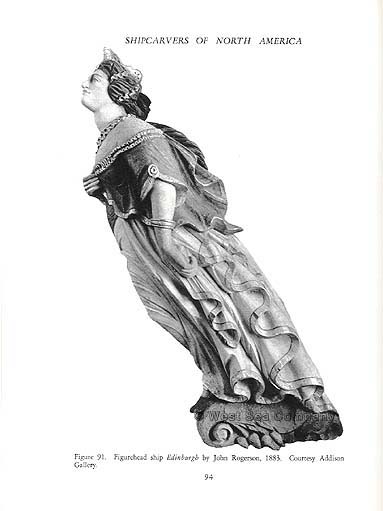
IDENTIFIED SHIP'S FIGUREHEAD. Spectacular 19th Century carved and painted wooden ship's figurehead from the North American bark EDINBURGH. This stunning example of the ship carver's art is dressed in classical attire, adornmed with a ribbon-carved gilt necklace and tiara, central oval brooch and bracelets on each wrist. She poses a striking stance, forward leaning with her right arm across her bosom as she stands on the original base, flanked by Acanthus scrolls. This important artifact was sculpted by the well known Canadian wood carver John Rogerson (1837-1925) who worked in St. John, New Brunswick in the second half of the 19th century. The figurehead stands 73 inches tall inclusive of its small wooden display pedestal and weighs approximately 400 pounds. It is in an outstanding state of preservation with approximately 90% original surfaces and paint.
The EDINBURGH was a Canadian-built and registered 3-masted barque of 203 1/2 feet launched by William Charland, Jr. of St. Joseph de Levis Quebec, Canada in 1883. After 26 years of service, she met her demise in the port of Bermuda where she foundered in 1909. This figurehead was first owned by the American Consul to Bermuda, William H. Allen and was proudly displayed in his garden for several years. In the 1920's she became the property of Francis Turnbull Meyer, a successful businessman from New York. Mr. Meyer, long a patron of the arts, donated the figurehead to the Addison Gallery of American Art at the Phillips Academy, Andover, Massachusetts in 1933 where it was on public exhibit in the Maritime Wing until 2002.
This famous figurehead is well documented in associated literature. In the book "Shipcarvers of North America," M.V. Brewington, 1962, Barre publishing Co., Barre, Massachusetts, the entire page 94 is devoted to a full length photograph of the figurehead with accompanying text. In the landmark work "Treasury of American Design" by Clarence Hornung, published by Abrams, Inc., New York, 1976, the first chapter is entitled "Forgotten Figures Fore and Aft." The frontispiece of chapter I, page 6, is the full page image of this beautiful figurehead
 |
 |
 |
|
|
|
|
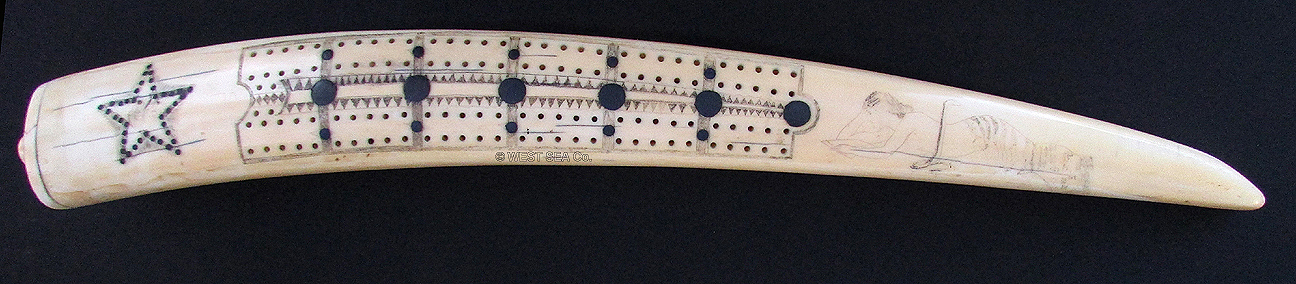 |
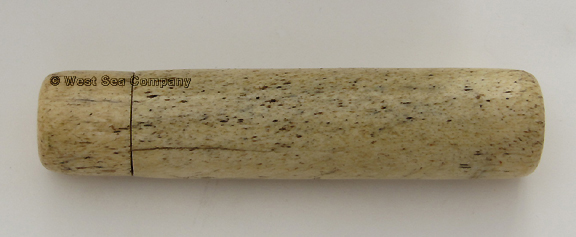
SCRIMSHAW NEEDLE CASE. Exceptional sailor-made sailmaker’s needle case carved entirely out of a single piece of dense panbone from a sperm whale with a press-fit cap. The exterior of this example of working scrimshaw is finely decorated with the scrimshawed portrait of a maiden intently gazing into the distance with her raised whale oil lamp. The dress and hairstyle of the young woman are indicative of the 1860’s. The hollowed interior of the case contains 4 sailmaker’s needles and two pieces of beeswax, one wrapped in sinew. Each of the classic triangular needles is signed “W. BARTLEET (sic) & SONS.” 7 inches long by 1 12/ inches in diameter. Excellent original condition. Very RARE!
Provenance: West Sea Company auction April 28, 1991, lot 147.
 |
 |
|
|
|
 |
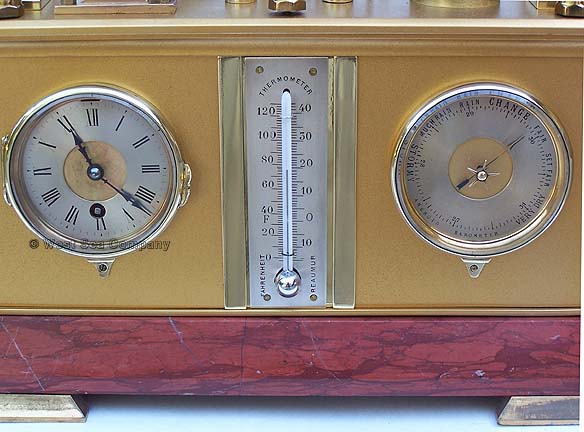
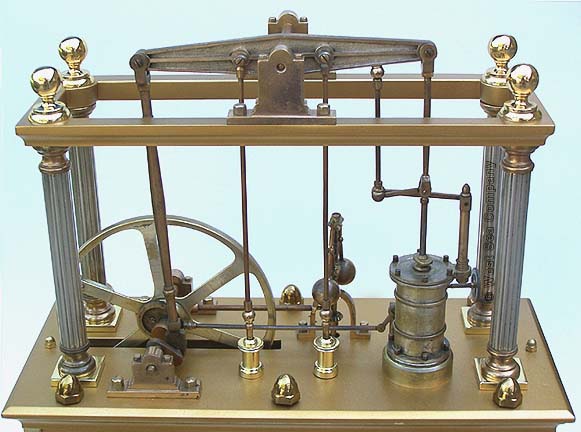
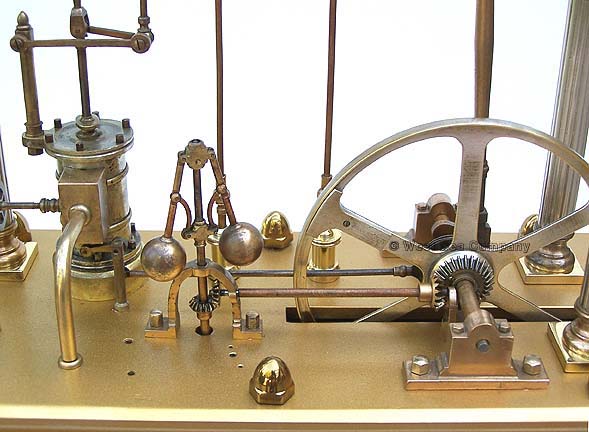
FRENCH INDUSTRIAL CLOCK. The most marvelous, most complicated AND most expensive clock set we offered in our 35 years in the antiques business! This compendium consists of a clock, barometer and thermometer housed in a gilded, silvered heavy brass and bronze case mounted atop a marble plinth set on gilt brass feet. The early 8-day clock has a jeweled movement with scarce "cylinder escapement" which runs ornate blued steel hands on a silvered dial marked in Roman numerals with a minute chapter. The matching barometer is marked "ANEROID BAROMETER" and is calibrated in inches of Hg from 27 to 31 in 5/100th increments, with the standard weather indications, "STORMY, RAIN, CHANGE, FAIR," etc. It is complete with brass set hand and a delicate "star" set knob. A third instrument, the Hg bulb thermometer, is marked "FAHRENHEIT" and "REAUMUR" (sic) on its silvered scale calibrated from 0 to 120 degrees F. and -15 to 40 degrees R., respectively. All three instruments are set into an incredible presentation in the form of an early mechanical steam engine with elaborate frame, rocking beam, flywheel, flyweight governor, steam chest, pumps and more. The whole complex train actually moves with a fascinating synchronous motion driven by an extremely powerful all brass spring clockwork movement housed within! Winding is effected using a huge number 14 key on the large arbor to the right. The mechanism runs for about 30 minutes on one winding. The 7 day clock is wound through the front via the hinged bezel. Overall condition is absolutely outstanding, virtually perfect in every sense. Both the clock and barometer movements were thoroughly overhauled by a professional and are in tip top operational condition. Cosmetically the entire apparatus is in near perfect, fully restored condition! It measures 11 3/4 inches wide, 5 3/4 inches deep and stands 13 inches tall, weighing an impressive 25 pounds! Circa 1870.
 |
 |
 |
 |
 |
|
|
|
|
|
|
 |
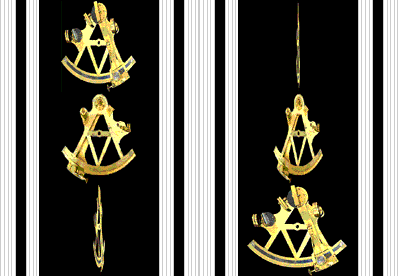
IMPORTANT IDENTIFIED EBONY SEXTANT. Extremely rare late 18th century ebony and brass sextant made by the famous English nautical instrument making firms "Spencer, Browning & Rust, London" as engraved on the ivory maker's label. It was sold by the American nautical maker and chandler, "Gedney King, Boston" to the famous American ship Captain Larkin Turner. This rare instrument has its full set of index and horizon filters and a braced brass index arm with ivory vernier. The inlaid ivory scale is marked in 20 arc minute increments from 0 to 137 degrees and is signed in script "SBR" indicating it was calibrated on the firm's dividing engine. The tangential fine adjust knob in concert with the vernier allows a reading to an accuracy of 30 arc seconds. It has a sculpted rosewood handle and is equipped with an height adjustable eyepiece with pivoting peep, which accepts interchangeable sighting tubes. Both tubes are present in the original large hand-made "keystone" oak box with original lock, fancy brass escutcheon and hook and eye closures. Within the lid is the trade label of Gedney King, Boston. The instrument itself measures one foot high on the index arm with the same dimension across the large arc. The early engraved Gedney King trade label is a thing of beauty, and represents a rare form of early American advertising which is extremely valuable in its own right. The instrument and its box are in a remarkable state of original preservation. In the box is a small envelope which reads "The "Tag" and the Gift Card of Capt.n Larkin Turner's Sextant." Inside it are two original old hand-penned documents. The first is a small stiff label reading "Capt L. Turner." The second reads "By Capt L. Turner purchased of G. King in the year 1804 & Presented by him to T.L.T. July 1839." Another larger document reads "Observations of Capt. Larkin Turner" dated "Sept 21, 1832." This is an incredibly rare early navigational instrument by famous makers with documented provenance from a famous American sea captain. A true museum piece!
Capt. Larkin Turner was born in Grafton, Massachusetts in 1781. At the age of fourteen he was "put out" to learn the trade of shoemaker. But at the age of sixteen he began his new career as a seaman with his uncle's support. After passing through all the grades of an arduous seafaring apprenticeship he gained his first command of a vessel from the counting house of the merchants, William Gray, Esq., at the tender age of 22.
A strict disciplinarian, severe on occasion, he was a cautious manager on shipboard, but generally kind to his crews. He spent 40 years at sea navigating the world. In his "retirement" years 1836 and 1837, he twice representented his town of Charlestown in the the Massachusetts Legislature. He died in 1854. (Recounted by Thomas Larkin Turner, son, circa 1850. Abstracted from the original journals now in the library collection of Mystic Seaport, Mystic, Connecticut).
Those journals indicate that Captain Turner served on the following vessels, for a minimum duration of the dates shown:
Ship CALUMET, January 31, 1804 - August 30, 1805
Ship PRINT, April 19 - August 9, 1806
Ship PACTOTUS, March 15 - August 21, 1807
Sloop NABBY, September 10, 1810 - November 28, 1811
Brig TRIM, August 20 - September 24, 1819
Brig PALESTINE, February 3 - November 20, 1832
Ship HENRY, October 13 - November 4, 1834
M.V. Brewington in "The Peabody Museum Collection of Navigating Instruments," Peabody Museum, Salem, Massachusetts, 1963, notes that "The firm, Spencer Browning & Rust, first appear in the London Directories between 1780 and 1784 at 327 High Street, Wapping, London. Clay and Court in the History of the Telescope state the firm was at 123 Wapping in 1791, but if so, it was back at 327 High Street in 1797 according to the London Directory of that year. In 1798 they moved to 66 High Street Wapping, and remained there until 1840.
In the same reference, Gedney King is reported as being born in Salem, Massachusetts in 1777. He was apprenticed to his famous uncle Benjamin of Salem. By 1800, he was an instrument maker first on Fore Street and in 1805 at 10 North Row, Fish Street, Boston. In 1832 the firm name changed to Gedney King & Son, 7 Broad Street, Boston.
 |
 |
 |
|
|
|
|
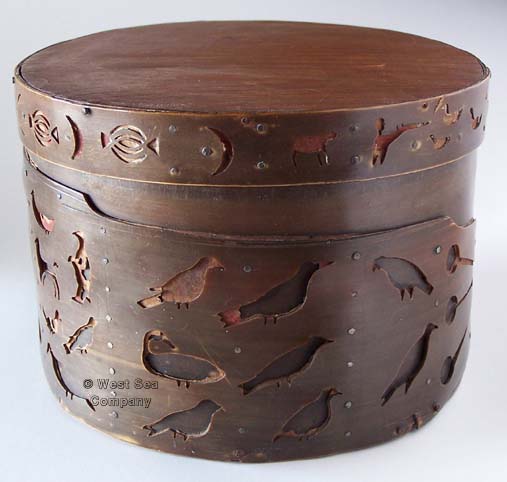 |
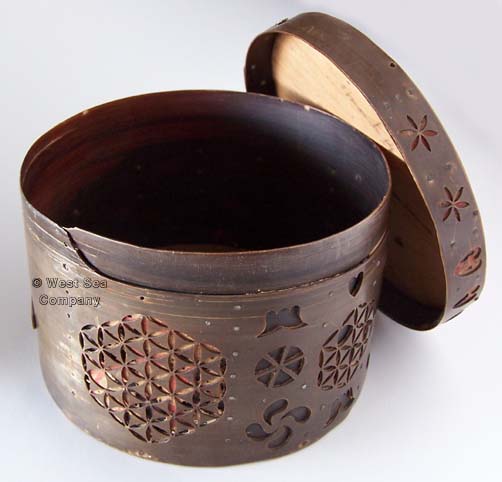
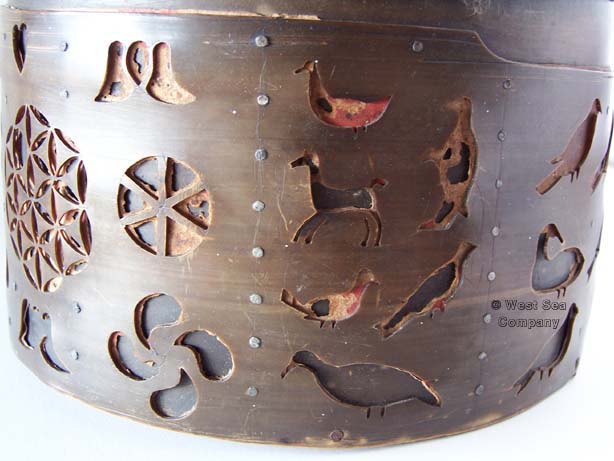
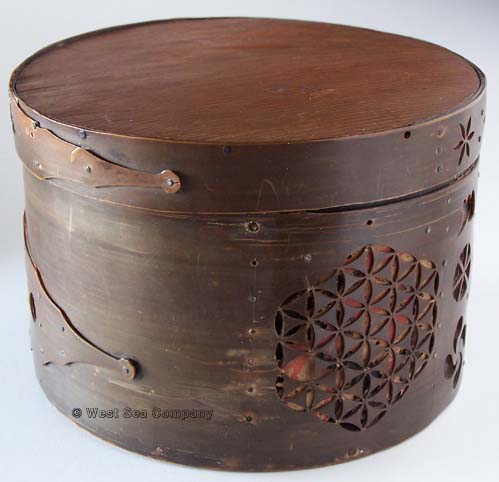
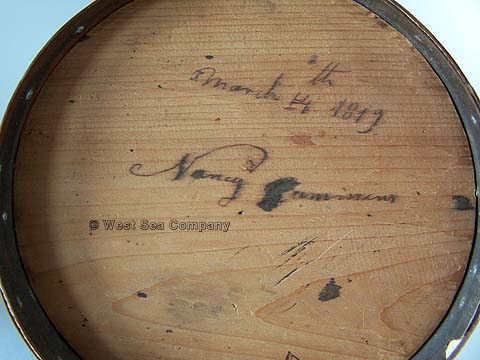
VERY EARLY SCRIMSHAW BOX. A very rare identified and dated example of whaleman's work embodied in a reticulated baleen box. This early form scrimshaw ditty box is made using laborious cut-out "silhouettes" rather than engraved designs typical of later baleen examples. Scores of these silhouettes surround the entire circumference, including a wide variety of varying birds, a dog, a horse and even a hunter with rifle shooting a duck! Then there are the well-recognized sailor designs too such as pin wheels, hearts, star bursts, crescent moons, angel wings and complex geometrical patterns. These finely detailed decorations would have been difficult enough to engrave, let alone cut-out with such delicate precision! The baleen used in making this box consists of one long piece wrapped twice, forming two layers, riveted together with colored paper sandwiched in between. It terminates on the outside with a single classic "Shaker-style finger." The top and bottom of the box are pine wood pinned through the baleen. The lid so formed, fits on with a nice press fit. Of particular note is the fact that the underside of the lid is signed in pen, "March 14th 1819 Nancy Caminius" and the top is carved with the initials "NC". The date of 1819 makes this example one of the earliest known dated scrimshaw in existence! Bear in mind, the first signed and dated scrimshaw was produced by Frederick Myrick on the whaleship SUSAN some ten years later! The overall condition is excellent and very sound. There are two cracks in the rim of the box which are covered by the lid. A couple of very minor losses exist in the geometric designs. And as expected, the underlying paper is faded with losses. Remarkably though, there is no worm damage typical of most old baleen and there are no other cracks, chips or losses! 6 inches in diameter by 4 inches high. A museum piece!
In his landmark work on scrimshaw, "Scrimshaw and Scrimshanders, Whales and Whalemen, 1972, N. Flayderman & Co., Inc., New Milford, Connecticut, author Norman Flayderman depicts a cut-out busk on page 166 with the caption "A rare form of fully pierced busk, courtesy Nantucket Historical Ass'n." Only one similarly pierced baleen basket is pictured in the entire book with the caption, "Those with large pierced open-work are often backed with colored paper of tinfoil to accentuate their delicacy." Neither Michael McManus in "A Treasury of American Scrimshaw," nor Martha Lawrence in "Scrimshaw The Whaler's Legacy" depict an example of a cut-out baleen box!
 |
 |
 |
 |
|
|
|
|
|
|
|
|
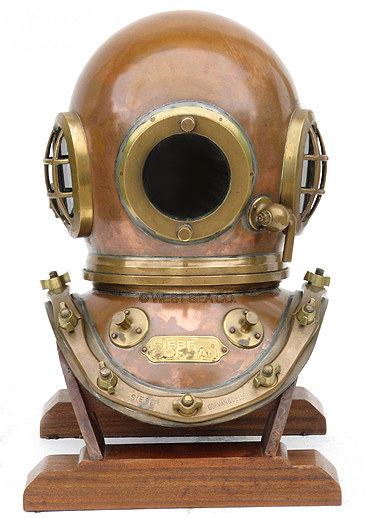
SIEBE GORMAN DIVING HELMET. Scarce, especially fine English-made deep sea hard hat diving helmet. This 12-bolt, 3-light commercial helmet was made by the legendary diving equipment manufacturer, Siebe Gorman of London, England as identified on the embossed brass maker’s plaque riveted to the breastplate which reads, “SIEBE GORMAN.” The handsome spun copper and brass bonnet has a simple front port which threads on with a leather gasket and 2 prominent lugs for turning. The 2 oval side ports are protected by raised brass grills of traditional form. A spitcock is located on the diver’s left and an air supply gooseneck with non-return valve is at the rear of the bonnet. A second gooseneck with cover marked “TELEPHONE” afforded communication with the surface. An exhaust valve with 8-point handle is positioned abaft the right port light. The large brass neck ring is of the interrupted thread design seating the bonnet on the breastplate with a leather O-ring. A small pivoting “keeper” at the back of the neck ring assures proper alignment. The breastplate has 2 front lugs and 4 brails consecutively numbered and stamped “SIEBE GORMAN & CO LTD” in front. The neck ring of the bonnet and the corresponding ring of the breastplate bear the matching serial number XXXXX* respectively. The interior of the helmet is tinned with air channels running above each port. An air release valve operated by the diver’s head is located behind his left ear. This helmet is in unbelievbly wonderful original condition, given its age. Cicrca 1920. Diving pioneer August Siebe was born in Saxony in 1788. He was educated in Berlin and apprenticed as a caster of fine parts for instruments, guns and watch making. In 1816 he moved to England and became a British subject in 1819. His initial work there was as an inventor and fabricator, including a breech-loading rifle, paper making machine and a carbon arc lamp. However it was his invention and production of the first commercially viable diving apparatus in 1837 that brought him fame. Up to that time, divers had used crude “open” systems which were awkward and dangerous, requiring the diver to be vertical at all times. Siebe introduced a “closed” diving dress with hard hat which allowed the diver freedom of movement without regard to position. Virtually every hard hat made since has relied upon Siebe’s original design. Siebe was soon joined by his son-in-law William A. Gorman to form the company Siebe Gorman, which produced all manner of diving equipment. Augustus Siebe died in 1872. But his legacy lived on in the company that bore his name well into the 20th century. . |
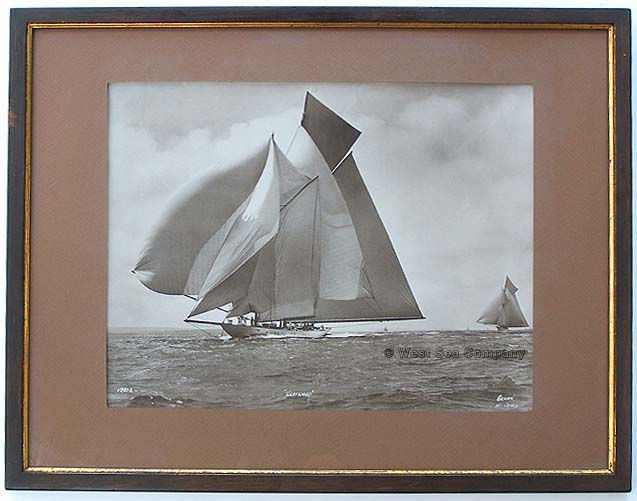 |
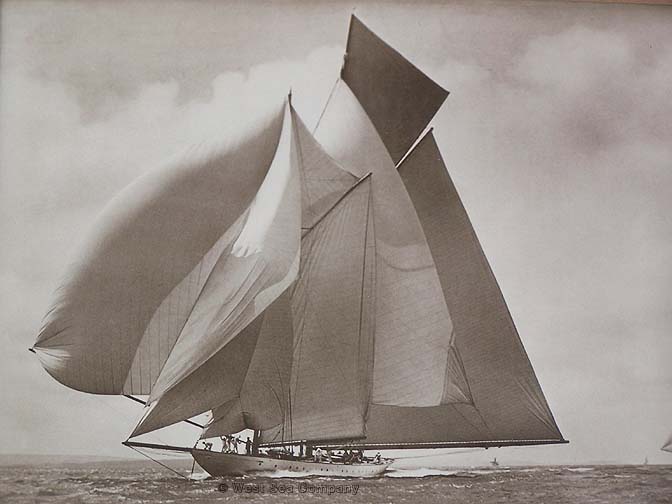
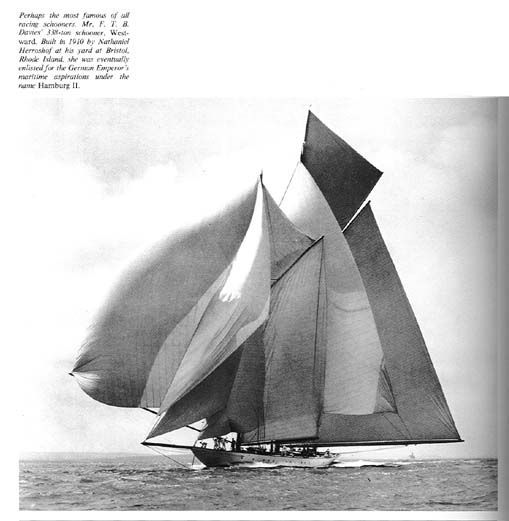
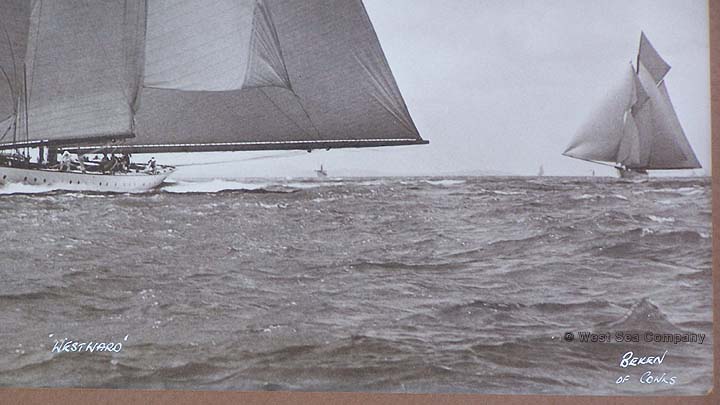
19.50 FAMOUS PHOTOGRAPH. Absolutely splendid early 1900's photograph of a magnificent schooner yacht on the downwind leg of an open ocean race under every single stitch of sail she can muster! This famous photograph was taken by "Beken of Cowes" Isle of Wight as signed lower right. It is titled "WESTWARD" in the center and serial numbered "12203" lower left. The lovely original sepia tone silverplate image shows several crewmen on the deck of WESTWARD busily engaged in keeping her well in front of the trailing competition shown far right. The large size image measures 11 1/2 by 14 inches sight and is matted under old wavy glass in its original rosewood frame with gold liner measuring 17 by 21 inches. Absolutely outstanding condition in every respect.
The book "YACHTING" A Pictorial History by Peter Heaton, published by the Viking Press, New York, 1972, depicts this very photograph on page 68 with the caption, "Perhaps the most famous of all racing schooners, Mr. F. T. B. Davies' 338-ton schooner, Westward. Built in 1910 by Nathaniel Herroshoff at his yard in Bristol, Rhode Island, she was eventually enlisted for the German Emperor's maritime aspirations under the name Hamburg II."
Anthony Peluso, maritime historian, author, marine art and photography authority has seen this image. Mr. Peluso notes that WESTWARD was originally built for New York industrialist and yachtsman Alexander Smith Cochran. She was skippered by Charlie Barr, a most distinguished captain and successful defender of the America's Cup in 1899, 1901 and 1903. Under his command,WESTWARD beat Kaiser Wilhelm's yacht METEOR in a 1910 race at Kiel. Barr died shortly thereafter and Cochran sold the yacht.
Of Frank Beken, Mr. Peluso states, "He was a chemist, who began as an amateur photographer. He first displayed his yachting photos in his store window sometime around 1888 and the rest is history. They are now in the fourth (?) generation at Cowes on the Isle of Wight. I think they are without much doubt the best that ever was, from whatever period. They had early outstanding rivals like George West & Son at Gosport, Kirk & Son also at Cowes, but Beken was the survivor. Like Rosenfeld they bought the estates of their rivals and their images are subsumed in their collection.
 |
 |
 |
|
|
|
|
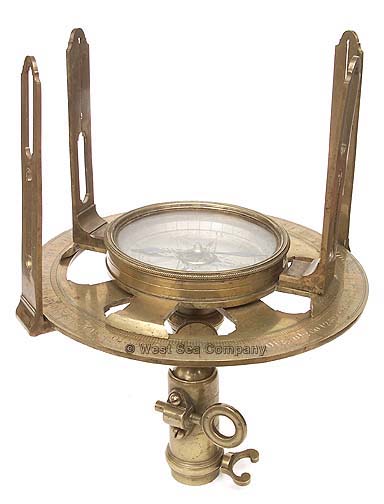 |
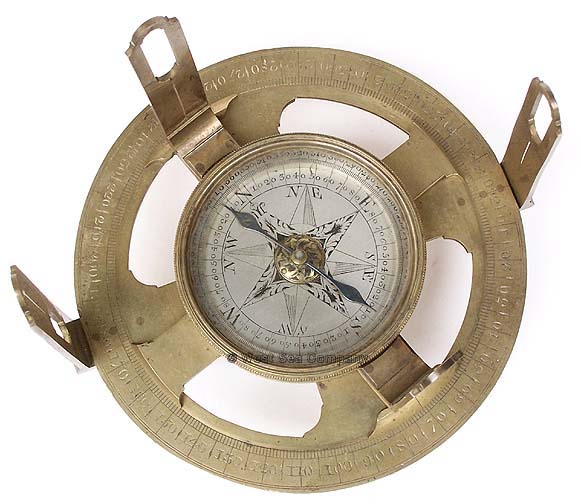
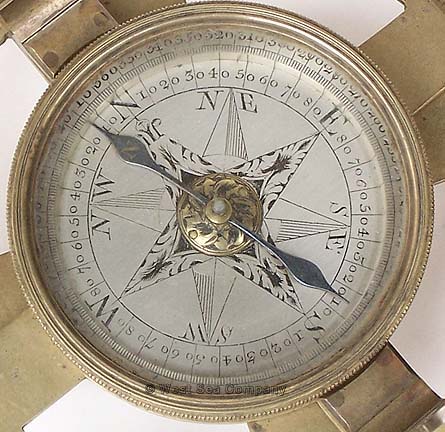
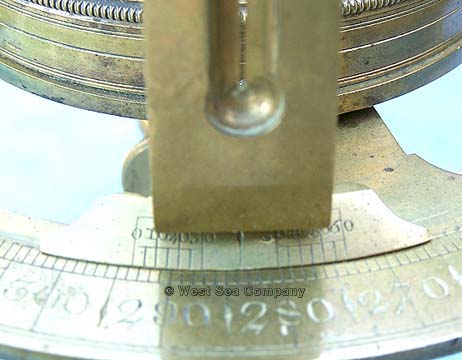
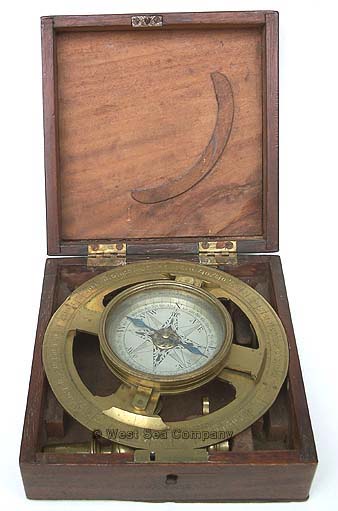
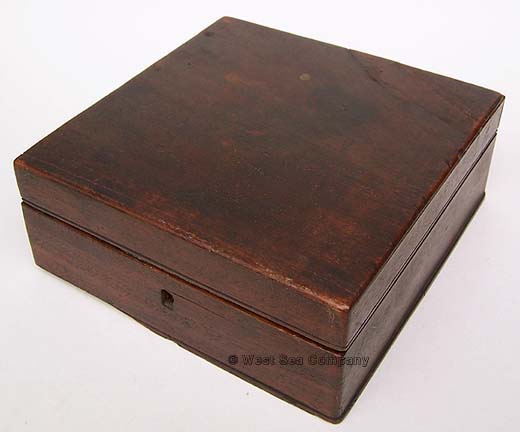
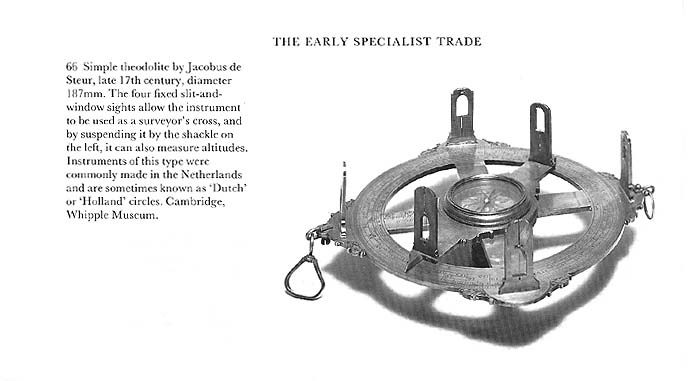
9.90 CIRCUMFERENTOR. Rare, first quarter18th C. English circumferentor, complete in all respects with its original, rarely-found wooden case! This early form surveyor's instrument also known as Digge's theodolite or "Holland circle," bears a decoratively-engraved central compass using "wheathead" motifs typical of 17th and early 18th century English design. The silvered dial is marked with cardinal points and intercardinal points of the compass, in English, and is divided to single degrees around its periphery. The compass is flanked by 2 sighting vanes which revolve with it on a second full circle. One of the vanes has a vernier scale which allows for a reading down to one minute of arc. The outer circle bears a hand-engraved scale divided to single degrees and a second set of sighting vanes. The instrument is supported atop its original ball and socket joint which would mount atop a "Jacob's staff" for use. Each vane is detachable, attaching with a close tolerance "dovetail." The ball and socket support attaches to the instrument with a simple press fit and locking thumb screw. These features allow the whole instrument to disassemble and fit neatly within its wooden carrying case with lock. The entire presentation is in outstanding original condition. The instrument itself measures 6 inches in diameter and stands 8 1/4 inches high. The box is 6 1/4 wide by 6 1/2 inches deep and is 2 1/2 inches thick. This is a true museum piece, circa 1730 or earlier.
Thomas Digges (1546-1595) was an English astronomer and mathematician who wrote about and produced both navigational and surveying instruments. He devised a cross staff with a transversal scale which was the forerunner of the scale used on early Hadley quadrants. (J.A. Bennett, "The Divided Circle," 1987, Christie's Ltd., Oxford).
 |
 |
 |
 |
 |
 |
|
|
|
|
|
|
|