Mr. Samuel PENNINGTON
Editor MAINE ANTIQUE DIGEST
P.O. Box 645
Waldoboro, ME 04572
Dear Sam,
It was a pleasure meeting you recently during the Kendall Whaling Museum's scrimshaw symposium. Certainly we were all impressed by the body of knowledge represented and presented.
When it was over I was equally in awe of how much still remains to be explored within this field, and how much of it is subject to interpretation.
The symposium participants consistently trumpeted the axiom that there is no substitute for handling and examining bulk quantities of period antique scrimshaw in order to obtain a bona fide "feel" for what's real and what isn't. Yet all admitted fallibility in judgment -- even the most seasoned of recognized "experts."
My whispered proposal to promulgate a basic set of authentication guidelines was met, in most cases, with negativity. "It's impossible." "There are no short cuts." "It's a gut feeling." Apparently, the theory goes, you have to gain knowledge the old fashioned way... you earn it! How true! There's no substitute for experience.
Yet I maintain that there ARE some basic bench marks by which the serious student of period scrimshaw, indeed even the novice, can gauge his perceptivity in evaluating a generic piece of scrimshaw. One of the conclusions propounded by the symposium was the value of research, methodology, and knowledge as tools in unlocking the mysteries of scrimshaw.
Here then is a portion of the methodology that we here at WEST SEA COMPANY use in our evaluations of scrimshawed whales' teeth:
1. Cut and size. Whalemen were not as enamored with the size and mass of whale's teeth like collectors today. More often than not a tooth was trimmed or squared off at the bottom by sawing, frequently so that it would stand upright on its own. As size of teeth increased there was less proclivity on the part of a whaleman to scrim them. Today the largest old teeth encountered are usually blank.
 |
|
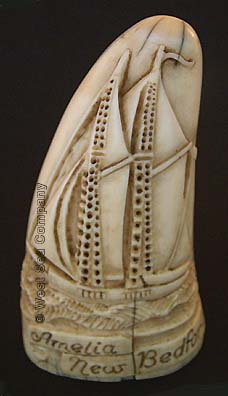
A very unusual form of authentic scrimshaw, consisting of a whale tooth carved in relief depicting an identified ship and its home port. Only 4 inches tall, this tooth was originally much longer. Its carver cut off a substantial portion of the bottom so that it would stand upright. Alexander Starbuck in his comprehensive reference work "History of the American Whale Fishery" indicates a single voyage of the Whaling Schooner AMELIA hailing from New Bedford. It was in the year 1877, precisely dating this work. |
2. Patina. A true age patina on a tooth is generally irregular, conforming to the striations of the grain and the difference in the density of the dentin and pulp. The patina generally varies from side to side and from the inner root canal to the exterior surface. Patina is the result of the environment in which the object was maintained. For example, a tooth kept in a household of smokers might exhibit a rich dark brown patina. Whereas two of the famous "Susan's teeth" stored in the protected environment of the Peabody museum since 1831 are starkly white. It is also documented that some shipboard scrimshanders did purposely patinate their work by soaking in a brine solution enhanced with pigment. Conversely, many contemporarily scrimshawed teeth are given an artificial "patina." Soaking a tooth in tea is one popular method. But contrary to a real age patina, the color tends to be consistent on the entire surface. Given the above observations, patina can be said to be a good indicator of age, but obviously does not guarantee it.
|
|||
|
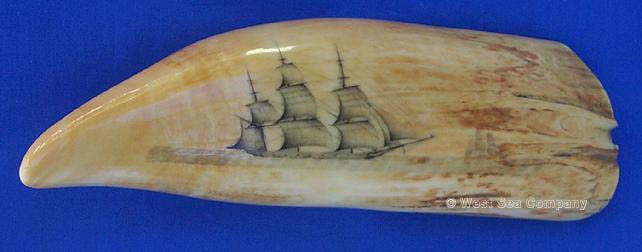
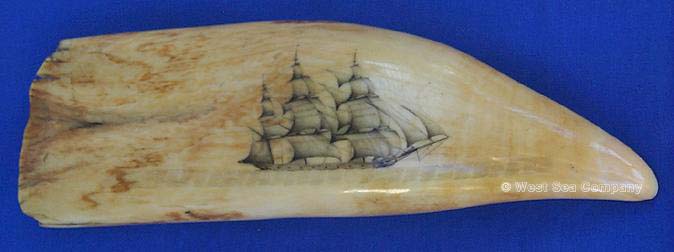
A spectacular example of scrimshaw done at the hands of one familiar with engraving. Perhaps the scrimshander of this bull whale's tooth was an artist/sculptor turned sailor. The work is extremely fine and reminiscent of that found on stock certificates and bank notes of the era. Yet, attesting to its whaleman origins, note that in the scene on the left, another vessel is depicted in front of the ship, hull down, over the horizon. This phenomenon is unique to the experience of a sailor! Also note the irregularity of the beautiful old patina on this specimen. Artificially aged and patinated teeth, such as those soaked in tea, will exhibit a more uniform color overall. |
3. Surface. Period whale tooth scrimshaw was usually prepared by whittling down the surface with a jackknife (See Flayderman, Scrimshaw & Scrimshanders, Whales & Whalemen, p. 44) or carpenter's tool, further smoothed with an abrasive such as shark skin, then finally polished by hand. The process left the surface smooth but with slight irregularities. Many contemporarily prepared teeth are done with mechanical means such as a grinder and buffer, producing a high sheen. But because the process is labor intensive, frequently only one side has been smoothed. Nearly all antique teeth were smoothed all over.
4. Work. a.
A good percentage of early scrimshaw was done on board ship with
fresh, soft, raw material. As such early work can be heavy
with distinctive "furrowing" or raised areas immediately adjacent
to the engraving. New (and old) work done on hard, cured material
will not exhibit this characteristic. In fact most modern work,
done on old teeth, will exhibit minute fracturing and chips along
the lines of engraving.
b.
Usually the technical aspects of a sailor-scrimshawed scene are
correct with regard to rigging, boats, anatomy, topography, voyage
facts, etc.
5. Cracks. Most ivory cracks and checks with age. A piece of scrimshaw done prior to the onset of age cracks will not exhibit pigment within the crack, unless re-inked. Conversely, a dead giveaway that an old tooth has been re-inked or contemporarily scrimshawed is the presence of pigment in age cracks.
 |
|
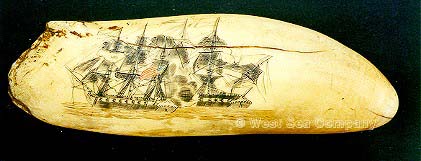
Note the age crack running through the scene on this old example of a scrimshawed whale's tooth. No pigment has migrated into the crack, but it does contain "good dirt". |
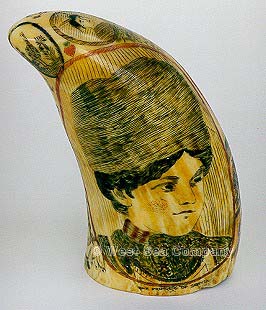
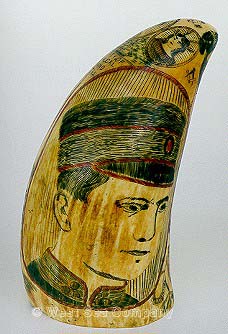
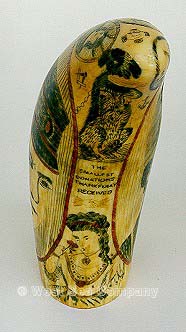
6. Inking and coloration. Early scrimshanders worked with limited resources, and therein lies much of the modern fascination with their beautiful results. Pigments were limited to that which was on hand: lampblack, ink, iron oxide, organic substances, and sometimes paint. The use of color ("polychroming") was relatively infrequent, but when present, was muted. When color was used, red and shades thereof, was the most popular.
|
|||
|
Three views of an exceptional late 19th century scrimshawed whale's tooth which exhibits lovely, darkly inked engraving referred to as "intaglio." Note the subtle use of red polychroming. Again, note the uneven distribution of patina. |
7. Wear. Subtle timeworn aging is difficult to fake. The pigment used to "ink" old work is often times literally "worn-out." Look for rounded or worn surfaces characterized by small scratches, themselves worn.
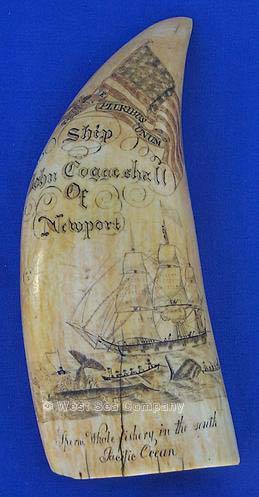
8. Data. Signed, dated, and identified period scrimshaw is RARE. Therefore, when evaluating an example with these attributes remember, "Guilty until proven innocent."
 |
|
One of the finest examples of scrimshaw ever produced -- that of the "Ship John Coggeshall of Newport" done by Albro (Thomas and/or Caleb) during one of three whaling voyages to the Pacific whaling grounds from 1835-1847. Identified scrimshaw is rare, and this superb example has all of the "bells and whistles!" Note the subtle use of red "polychroming." If scrimshawed whale's teeth are most valued by collectors, then this example would rate as an "ultimate find," easily commanding well into 5 figures. |
 |
|
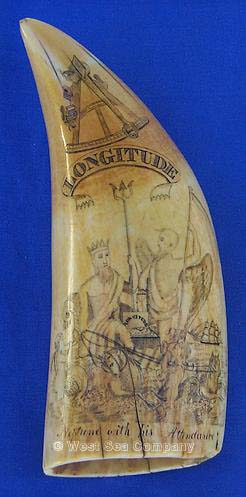
The reverse of the Albro tooth boldly depicting a mariner's quadrant above the legend "LONGITUDE." Below, Neptune and Father Time guard a chronometer. The legend at the bottom reads "Neptune with his Attendance (sic)." Note the sharp age crack in evidence on both sides of the tooth, and the uneven patina -- good signs of authenticity. |
 |
|
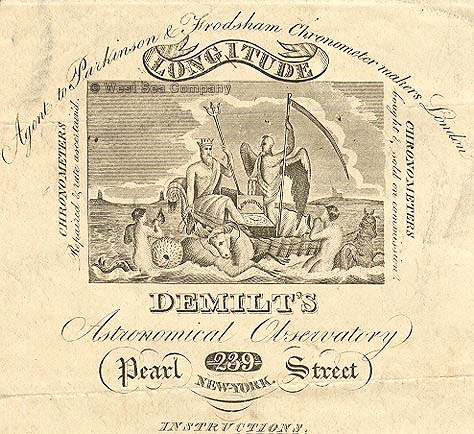
Chronometer rating sheet of "Demilt's Astronomical Observatory, New York" bearing a scene with an uncanny similarity to that on Albro's scrimshawed tooth. The rating sheet is dated 1841, right around the time that the Albro brothers were a whaling. Thomas Albro served as steward aboard the whaleship John Coggeshall during its 1835-1839 voyage to the Pacific. This meant that his work station was in the officers' quarters, placing him in daily proximity to the ship's chronometer. While Albro certainly took artistic liberty in depicting his version of the "Longitude," there can be no doubt that Demilt's engraving was his inspiration. This again lends credence to the observation that whalemen were good copy artists, but generally lacked much originality. |
9. Style. After one examines and compares numerous examples of authentic 19th century scrimshaw a sense of the whalemen's style can be garnered. 19th century scrimshanders evoked a certain charm and "naiveté" in their work which modern copy artists find elusive.
It is not for a minute my intention to suggest that these cursory guidelines are the last word in scrimshaw evaluation. Exceptions in all of the above categories exist. But these are some of the tests which the "experts," consciously or not, do use.
A little knowledge can be dangerous when incorrectly applied. There is no Rosetta stone to decipher the mysteries of antiques. But there IS a set of tangible standards and values which each of us use in evaluating areas within our areas of interest and expertise. Knowledge is king!
Sincerely,
Rod CARDOZA
WEST SEA COMPANY
San Diego, California
Most recently through the steadfast dedication and persistent research of Jack Chang, MD, of Denver, Colorado a tenth evaluation can be added.
10. Method. Dr. Chang's ground breaking research has revealed that there were four methods by which whalemen selectied a subject and more importantly how they put it it on a whale tooth.
a. The first was simply conceiving original artwork. Surprisingly, Dr. Chang's laborious comparisons of known scrimshaw to picture publications such as "Godey's Lady's Book," "Gleason's Pictorial", and "Harper's Weekly" indicates that the bulk of scrimshaw was actually copied from illustrations taken from publications of the era. It can be concluded that original scrimshaw artwork was relatively rare! The remaining three methods then, deal with how the "transfer" from existing images was made:
b. Of those, the first was simply copying by eye.
c. The remaining two methods involved ingenious mechanical copying. In the first of these, the image on paper was moistened and applied to the tooth. Then with a sharp instrument the scrimshander traced the outline of the image by pricking. Indeed, one form of scrimshaw is known as "pin prick" or stippling. However many scrimshanders went on to "connect the dots" (much like a child's puzzle) filling out the image linearly.
d. The second mechanical copying technique involved darkening the entire reverse side of the printed image with pencil lead. Once prepared the scrimshander would lay the printed image face up on the tooth and trace it using a pencil. In this way a "ghost image" was transferred to the surface of the tooth much like using carbon paper.
Thanks to the continuing dedication of staffers at the New Bedford Whaling Museum, New Bedford, Massachusetts, under the watchful eye of Curator and author Dr. Stuart Frank, Ph.D.., research continues on the source and nature of scrimshaw subjects, artisans and their methodology.
TO VIEW MORE GENUINE SCRIMSHAW,
CLICK HERE 
