West Sea
Company
SCRIMSHAW: IS IT
REAL?!
PART I:
What Is It?
By Rod Cardoza
©1999-2012 West Sea Company.
All rights reserved. Reproducing any part of
this article without the expressed written consent of the author
is
forbidden by law. Violators will be prosecuted.
All photographs courtesy West Sea Company unless otherwise
noted.
Perhaps no other field within
nautical antique collecting is more misunderstood or beset with bogus
examples than is the collectible known as "scrimshaw." There are 3
primary reasons for this:
1. Ignorance or lack of experience on the part of the
collector,
2. A surging market demand for the real thing which has driven
prices into 5 figures for desirable examples, and
3. The relative ease by which fakes and forgeries are dumped into
the marketplace resulting in market saturation.
It is our purpose here to aid the
collector and potential buyer of scrimshaw, so that he/she is aware
of what the genuine article is and the pitfalls associated with
buying it.
To a large part of the general
population the term "scrimshaw" has no meaning. To a small sector it
evokes the concept of ivory, bone, plastic, and other such surfaces
being decorated with engraved pictographs which are filled with a
pigment, resulting in an artistic scene. But this is only the tip of
the iceberg.
In reality the true definition of
scrimshaw is: The art of carving or otherwise constructing
decorative, often useful, objects as done by whale men, sailors, and
seafarers during the age of whaling. The basic materials were those
derived from whaling: products of the whale, but also shells, various
forms of sea life, the wide range of materials gathered in
ports-of-call, and the materials normally carried aboard whaling
ships including metals and woods. The artifact thus formed must have
one or more clear nautical association(s) with respect to the maker,
motif, method, or material to render it "authentic scrimshaw."
Why is this definition so important?
Because it clearly indicates what scrimshaw is and what it is not.
For the most part scrimshaw was done in the 19th century, although
18th and certainly 20th century examples are extant. Perhaps the most
important aspect of the definition is that it specifies that only the
"scrimshaw" done by whale men, sailors and seafarers during the
whaling era is real. What about all the rest? Well they may be
pretty, they may be art, they may contain authentic materials, and
they may have value. But they are NOT scrimshaw!
For many "in the know" about
scrimshaw, the term evokes the image of an engraved whale's tooth.
The whale's tooth has come to be the representative "icon" of
scrimshaw. Recent auction results also testify to its being the most
prized and valuable to collectors.
But certainly there are many other
forms of scrimshaw in addition to teeth. These include pie crimpers
(jagging wheels), busks (corset stays), fids, bodkins, pipes, seam
rubbers, ditty boxes, snuff boxes, neckerchief slides, swifts (yarn
winders), watch holders, rolling pins, jewelry, children's toys, ship
models, games, picture frames, candle stick holders, furniture,
needle cases, knives, tools, eating utensils, walking sticks,
baskets, ship's pulleys (blocks), cleats, dippers, clothespins,
sewing devices, etc., etc.
While the list may seem extensive,
and the output varied, there was, to a degree, a certain continuity
in the whalemen's production of scrimshaw. Of course there are
exceptions to every rule, but it can be said with a fair degree of
certainty that most whalemen found a form of scrimshaw in which they
were proficient and stuck to it. Frequently a certain "hand" can be
identified as having produced an object. Accordingly, it is not
uncommon for those of us who deal in scrimshaw on a daily basis to
come across nearly identical examples from diverse sources. In our
own experience for example, we have sold pie crimpers and swifts that
were exactly (or near enough so) like those exhibited in museums.
The following depict good examples
of genuine scrimshaw. It is important to recognize that all of these
varied examples are properly labeled as being "scrimshaw:"

|
|
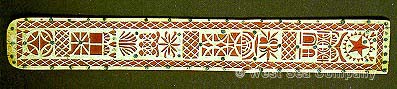
A superb example of a late 18th or very early 19th
century scrimshawed busk, or lady's corset stay. The
earliest busks were of wood, sometimes chip carved. Later
busks were made of panbone or baleen, and were frequently
profusely engraved ("scrimshawed"). This transitional
example features a wooden backing which has been overlaid
with an exquisitely reticulated panbone facing which is
riveted together. Note the recurring star, heart, and
diamond motifs -- a favorite amongst sailors.
|

|
|
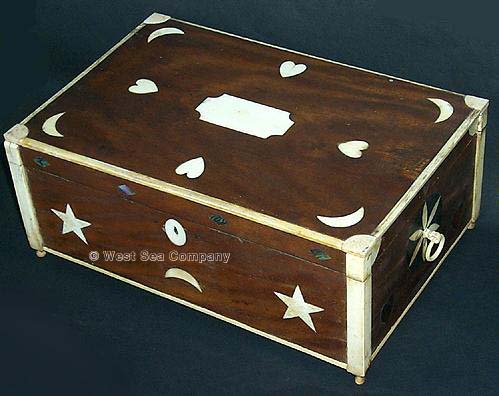
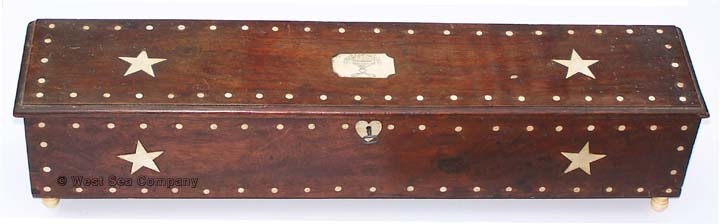
A typical example of a 19th century whaleman-produced
inlaid scrimshaw box, using the materials available:
tropical wood, whalebone, abalone shell, and whale tooth.
Again, note the stars and hearts.
|

|
|
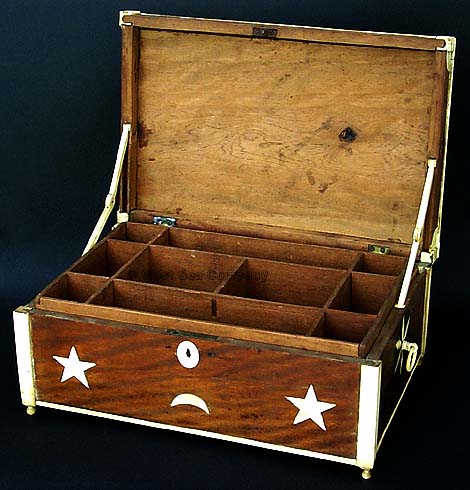
A view showing the interior of the scrimshaw box. Note
the very unusual whalebone folding lid support
stays.
|
|
|
|
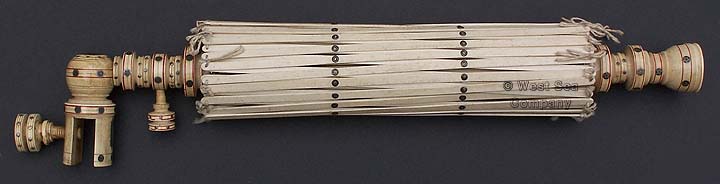
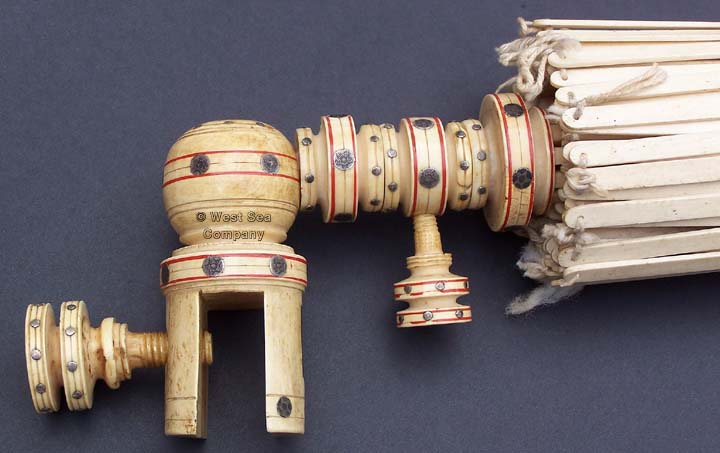
Important boxed scrimshaw swift made by Captain Henry
Dagget of the whaleship MALTA. Captain Dagget was an
accomplished scrimshander who was especially fond of making
swifts. At least 7 swifts by his hand are known -- this one
and the example in Mystic Seaport Museum being the best.
19th century whalemen proved to be good artisans, but in
general, their creativity and subject matter was limited to
certain "accepted" formats which they embellished with their
own creative "styles." In Captain Dagget's case, most of his
scrimshaw was presented to his wife Mary, often with the
initials "M.A.D." Tied with certain other "signature"
aspects of his work, his scrimshaw output was uniquely
identifiable.
|

|
|
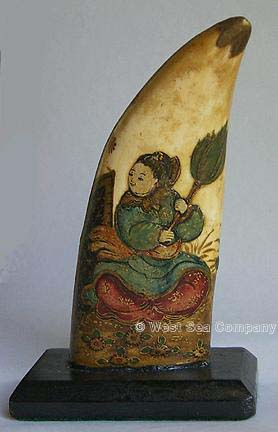
A very interesting Oriental twist on the "Western art
form" of scrimshaw. Here is a Japanese-painted sperm whale's
tooth. It is well known that the Japanese were/are whalers
in modern times, and this 19th century example affirms that
the Eastern cultures also prized whale's teeth. The painting
is done over a clay base giving a slight bas-relief effect
to the scrimshaw. Painted scrimshaw by Western hands is
extremely scarce, but some examples do exist.
|
|
|
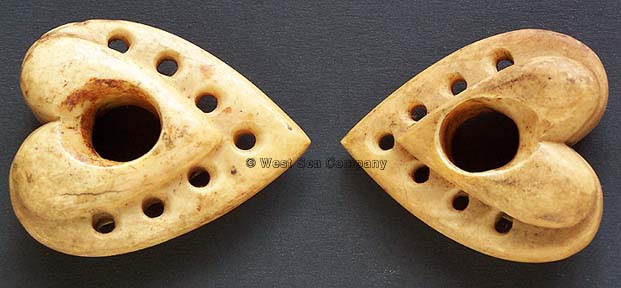
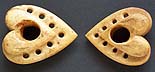
An exceptional, rarely found example of utilitarian
sailor scrimshaw in the form of carved whale ivory hammock
stays used to support a sailor's all important berthing in
the foc'sle. The care and detail lavished on these whale
tooth spreaders indicate the pride which ordinary seamen in
the 19th century took with their personally made belongings.
The heart shapes speak of the sailor's longing for his
"terra firma" accommodations at home. Note the very
distinctive discoloration and and surface wear telling of
years of exposure and use in the adverse conditions aboard
ship. The size of these 3 inch stays indicate that they were
fashioned from huge teeth!
|
|
|
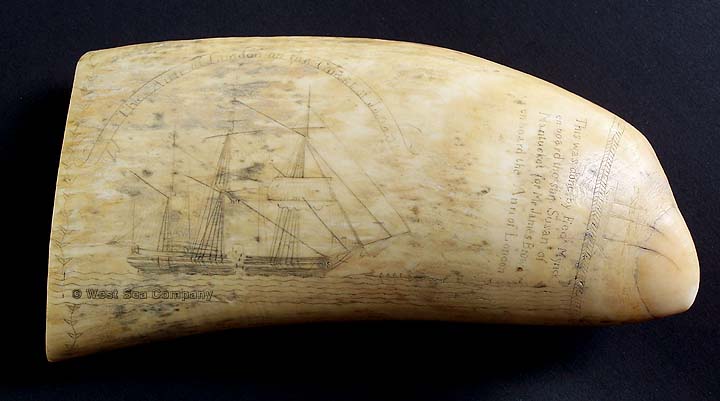
The holy grail of scrimshaw, an authentic
"Susan's Tooth," so named because it was produced by
Frederick Myrick on the whaleship Susan out of
Nantucket during a voyage to the Pacific spanning the two
year period from 1828 to 1829. The appeal of Susan's teeth
stems from Myrick's beautiful engraving of ships and whaling
scenes and his bent for documenting names, places, events,
ships and dates. Myrick is also the poet who coined the
famous phrase, "Death to the living, long life to the
killers, Success to sailors' wives & greasy luck to
whalers." This example depicts "The Ann of London on the
Coast of Japan" and is dated "January the 7th, 1829."
Thanks to the ground breaking work of the Kendall
Institute of the New Bedford Whaling Museum approximately 35
genuine Susan's teeth have been identified and catalogued.
Through intensive examination and research many of the
characteristics common to all of Myrick's output have been
documented. One of the more interesting discoveries was that
Myrick apparently used a template to aid him in portraying
ship details with speed and accuracy.
Remarkably, once Myrick returned to Nantucket on the
Susan in late 1829, he ceased producing scrimshaw!
Because Myrick performed his work on a single voyage, with a
chronological sequence of dates documented on the scrimshaw
he produced, it is believed by researchers that few if any
additional authentic "Susan's Teeth" are to be found.
Because a Susan's Tooth now commands in excess of 5 figures
on the rare occasion one comes to market, several clever
fakes have been attempted.
|
TO VIEW MORE GENUINE SCRIMSHAW,
CLICK HERE 
For further reading on the topic see:
1. Walter Earle, "Scrimshaw Folk Art of the Whalers," 1957, Whaling
Museum Society, Inc., Cold Spring Harbor, NY.
2. Norman E. Flayderman, "Scrimshaw and Scrimshanders, Whales and
Whalemen," 1972, N. Flayderman & Co., Inc., New Milford, CT.
3. Stuart M. Frank, Ph.D., "Fakeshaw: A Checklist of Plastic
Scrimshaw," 1993, The Kendall Whaling Museum, Sharon, MA.
4. Michael McManus, "A Treasury of American Scrimshaw, A collection
of the Useful and Decorative," 1997. Penguin Books, NY.


© 1998-2013 West Sea Company. All rights
reserved. Reproducing any part of this article without the expressed
written consent of the author is forbidden by law. Violators will be
prosecuted.